Published
Importing solar panels and inverters for a GB installation business
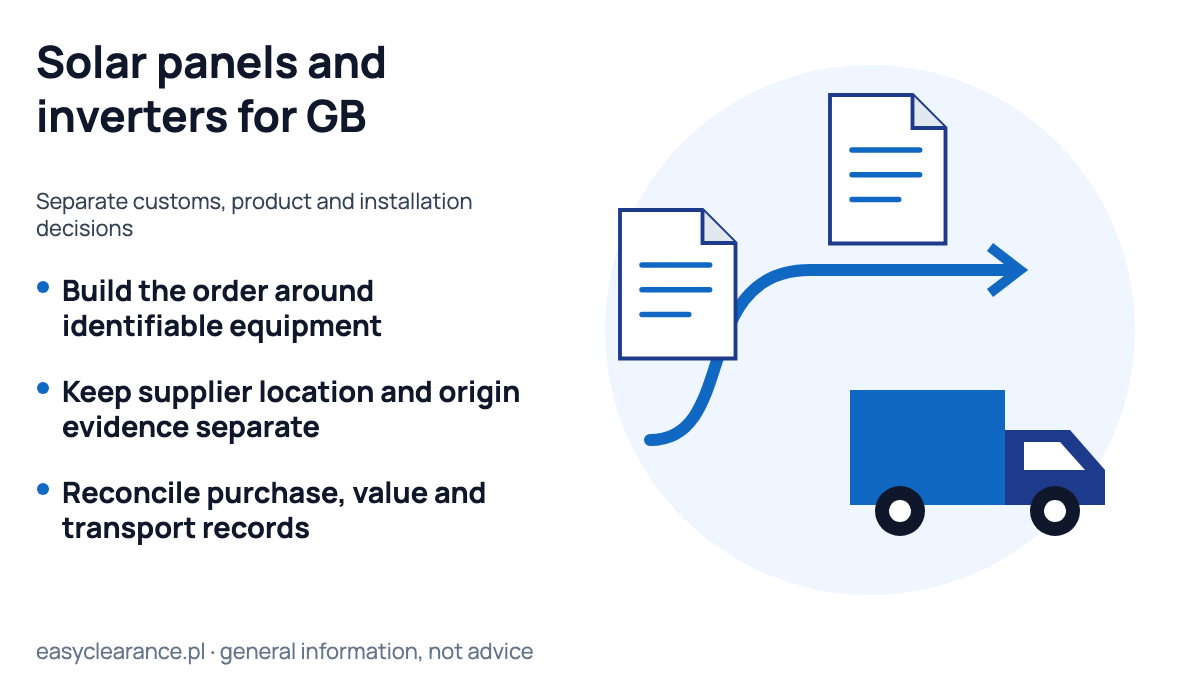
An installation business ordering solar panels and inverters from abroad needs a purchase file that remains useful after the supplier's sales team hands the order to its shipping department. “Solar kit” on an invoice tells the customs representative little about the individual goods or how the shipment matches the purchase.
This guide concerns equipment entering Great Britain: England, Scotland and Wales. It covers procurement and shipment preparation, with batteries excluded from the base scenario. Northern Ireland, product conformity decisions, electrical installation approval and site-specific requirements need separate assessment.
Build the order around identifiable equipment
Consider a fictional GB installer buying panels and inverters from an EU wholesaler for several projects. Some goods are delivered from the wholesaler's warehouse; another model is proposed as a last-minute substitution. The buyer needs to know exactly what will cross the border before accepting the substitution.
Prepare an item schedule containing:
- Manufacturer, model and supplier stock reference.
- Panel type and technical specification, including rated output.
- Inverter function, model and relevant technical data.
- Quantities, unit prices and currency.
- Separately listed mounting equipment, cables and accessories.
- Manufacturer information and evidence supporting any origin claim.
- Whether batteries or other additional equipment are actually included.
These are working procurement fields, not a claim that every listed document is a universal statutory customs attachment. Use the schedule to request missing information early. A photograph of the label helps identify equipment, but does not replace the technical documents or establish compliance.
Review classification before finalising the shipment
Ask the customs representative to assess each product against its description and specifications. Do not assume panels, inverters and mounting hardware share one classification because they appear in a single customer quote. Explain whether items are shipped separately or together and provide the actual package contents.
HMRC says commodity codes inform duty, VAT, preferences, licences and measures such as anti-dumping duties. It also advises checking a code supplied by an overseas supplier for UK use. Use the current tariff for the particular goods and import circumstances; this article assigns no code, rate or trade-remedy position. HMRC commodity-code guidance.
Record who checked the classification and what specifications they used. Reopen the question if the model, function or bundle changes before dispatch.
Keep supplier location and origin evidence separate
An EU warehouse address establishes where the shipment is leaving, not the origin facts needed for a proposed tariff treatment. HMRC explains that origin may differ from the country of purchase or shipment. HMRC rules-of-origin guidance. Ask the supplier to explain the manufacturer and provide the evidence requested by the representative. Leave an unsupported origin field unresolved rather than copying the seller's address into it.
Have the representative confirm whether any preference claim is appropriate for the documented goods. Avoid building the purchase budget around an assumed reduced duty or copying a rate from an older electronics article. The procurement team should retain the checked basis and any unresolved qualifications alongside the order.
Reconcile purchase, value and transport records
For a normal sale, give the representative the purchase contract, invoice and relevant payment evidence. Explain delivery terms, freight arrangements and separately charged items. HMRC's transaction-value guidance addresses the price paid or payable and required additions; the invoice total alone should not be assumed to settle every valuation question. HMRC transaction-value guidance.
Before collection, compare the final invoice with the item schedule and packing list. Check model numbers, quantities, package counts, weight and delivery address. Ask for a dated correction when documents conflict; preserve the earlier version and explanation.
In the fictional order, a supplier replaces four inverters with a different model. Pause the handover until the buyer, product reviewer and customs representative have the revised specification and documents. Commercial acceptance of a substitute should not silently update every other review.
Separate customs, product and installation decisions
Maintain three clear decision owners: the person preparing customs information, the person assessing product requirements, and the person responsible for the installation project. GOV.UK's business product-safety guidance explains responsibilities associated with importing or supplying consumer products and directs businesses to product-specific rules. Its general guidance does not determine the conformity route for a particular solar panel or inverter. GOV.UK product-safety guidance.
Request a product assessment covering applicable safety, documentation, marking and environmental obligations. Detailed electrical conformity conclusions are outside this guide. Record an unresolved assessment as a purchasing or release hold, with the responsible reviewer identified.
Likewise, keep site design, connection, installation acceptance and the tax treatment of the installation contract in a separate project review. Do not infer an import-VAT result from the treatment of work at the customer's property. Customs clearance should not be recorded as technical approval to install the equipment.
Inspect and reconcile the delivery
At receipt, compare pallet labels, model numbers and quantities with the cleared shipment file. Photograph visible panel damage, keep carrier and supplier reports, and quarantine disputed equipment for assessment. Record any replacement or credit against the original order rather than erasing the damaged delivery.
FAQ
Can one invoice cover the whole order?
Prepare sufficiently clear item lines and specifications for the representative to assess the actual goods. A single document need not mean a single product classification.
What if the supplier adds batteries?
Stop using this batteries-excluded brief and obtain a separate assessment of the revised shipment and transport requirements before booking it.
Can I approve a substitute after the goods arrive?
Resolve the substitution as early as possible. Keep the actual model visible in purchasing, product and customs records, and ask whether any submitted information needs correction.
For an initial route discussion, prepare the item schedule, supplier documents and delivery terms, then ask EasyClearance whether assistance is appropriate. Availability requires confirmation.
General information checked on 7 November 2026; individual customs, tax and product decisions require case-specific assessment.