Published
Mixed material furniture into GB: documents for classification review
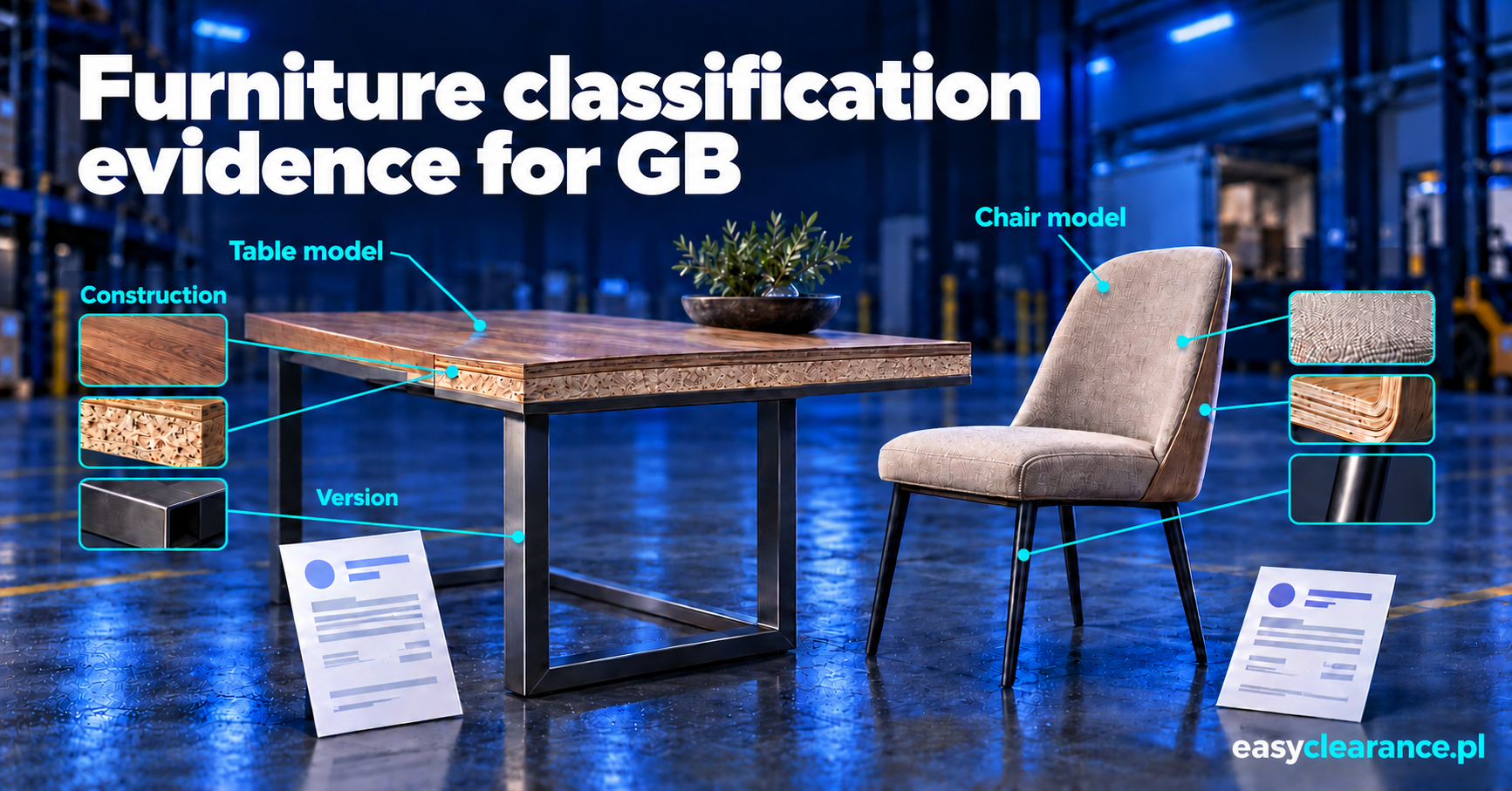
For mixed material furniture imported into Great Britain, useful classification documents describe what the product is and how it is constructed. A catalogue label such as “oak collection” may say little about a table with a veneered board top and steel base. Give the person reviewing the commodity code enough evidence to identify the actual goods, including differences between models, before preparing the import instruction.
This article explains how to build that evidence pack. It does not assign a code from a photograph or provide a general furniture import overview. Northern Ireland and EU declarations require separate consideration.
Start with the finished product's function
Consider an illustrative order containing dining tables with metal legs and veneered tops, plus upholstered chairs. The supplier's invoice calls everything “furniture, oak range”. The importer has a catalogue photograph but no specification sheet. This is a planning example, not a real shipment.
Ask the manufacturer to identify each model by its function, intended use, dimensions and construction. A table, seat and separately supplied component need their own descriptions. State whether the item arrives assembled, as a complete unassembled article, or as components supplied separately. Explain what is in the consignment rather than leaving the reviewer to infer it from the finished-product photograph.
HMRC's commodity-code guidance explains that codes are used on import declarations and help determine applicable duties and measures. It also cautions that a supplier's overseas code needs checking for UK treatment. Keep any supplier code as a reference to investigate, not as your only evidence.
Describe the structure behind the visible finish
Request a factual breakdown of the main components. For a table, distinguish the top, supporting frame, legs and surface covering. State whether “wood” means solid timber, plywood, fibreboard or another construction. For an upholstered chair, describe the frame, support structure, covering and filling separately where that information is relevant.
Photograph the underside and structural joints as well as the sales-facing surface. A finish can hide the material beneath it. If the supplier uses the same product name for different constructions, obtain the specification for the exact version ordered.
Do not make the reviewer choose between contradictory descriptions. “Solid oak table” on the invoice and “oak veneer on board” in the technical sheet should be clarified with the supplier. Keep the explanation and any corrected description in the pack. Material percentages may be useful supporting information when requested, but a percentage alone is not a complete classification analysis.
Build one evidence record per product model
Use a simple record that connects the SKU to the physical goods:
- Manufacturer, model reference and the supplier's invoice line.
- Product function, intended setting and dimensions.
- Main components and the material of each component.
- Details of frame, surface treatment, covering or upholstery.
- Clear photographs and, where helpful, an assembly drawing.
- Condition on arrival: assembled, unassembled or separately supplied components.
- Quantity and relevant package references.
- Proposed supplier code, with its jurisdiction and date if known.
- Any existing ruling relevant to the actual product and holder.
For the example order, create separate records for the tables and chairs. If one chair variant has a different frame, flag it instead of attaching the specification for another model. Keep filenames recognisable so the reviewer can connect a technical sheet to the correct invoice line.
Resolve missing evidence before selecting a code
A short list of open questions is more useful than a confident guess. Identify the missing construction detail, who will obtain it and which product lines are affected. Keep the classification decision separate from the commercial pressure to confirm a freight booking.
For uncertain recurring products, consider whether an Advance Tariff Ruling is appropriate. HMRC provides a GB ruling application route and asks for detailed goods information, with brochures, manuals, photographs or samples where appropriate. It distinguishes that route from the Binding Tariff Information process for Northern Ireland or the EU. An application is not an immediate release arrangement.
Keep other evidence clearly labelled
Do not mix the product specification with the packaging description. The table's construction and the pallet carrying it answer different questions. Keep origin evidence and any product-compliance documents in separate sections so reviewers can find them without assuming one document proves everything.
Customs classification does not itself establish permission to place furniture on the GB market. The government's import checklist separately directs importers to check marking, labelling and marketing rules. Obtain the relevant product assessment for the goods and intended market.
Frequently asked questions
Is a catalogue photograph enough?
It is a useful starting point, but it may hide the frame or substrate. Add the technical description and construction details needed to identify the exact product.
Can every item in a furniture collection use the same code?
Do not assume that a collection name establishes common treatment. Prepare each model's facts and ask the reviewer whether any grouping is justified.
What if the supplier changes the design before dispatch?
Send the revised specification and identify the changed components. Ask whether the classification needs reconsidering before using the previous instruction.
Send a product-specific enquiry
Use HMRC’s commodity-code and Advance Tariff Ruling guidance linked above when reviewing the evidence pack. Then contact Easy Clearance with the product records, importer, origin country, route and proposed shipment date. Ask it to confirm whether it can accept the requested review and GB work. No code or clearance outcome is promised here.
General operational information; official guidance checked on 3 October 2026. This is not binding tariff advice or an individual product assessment.