NCTS Phase 6 explained — ICS2 in the transit declaration: EU, UK and Poland
What NCTS Phase 6 is according to the European Commission, when it started in the EU, in GB (1.06.2026) and in Poland (3.08.2026), and what it means for T1 transit between the UK and the EU.
Author
easyclearance.pl teamPublished
2026-10-25
Updated
2026-10-25
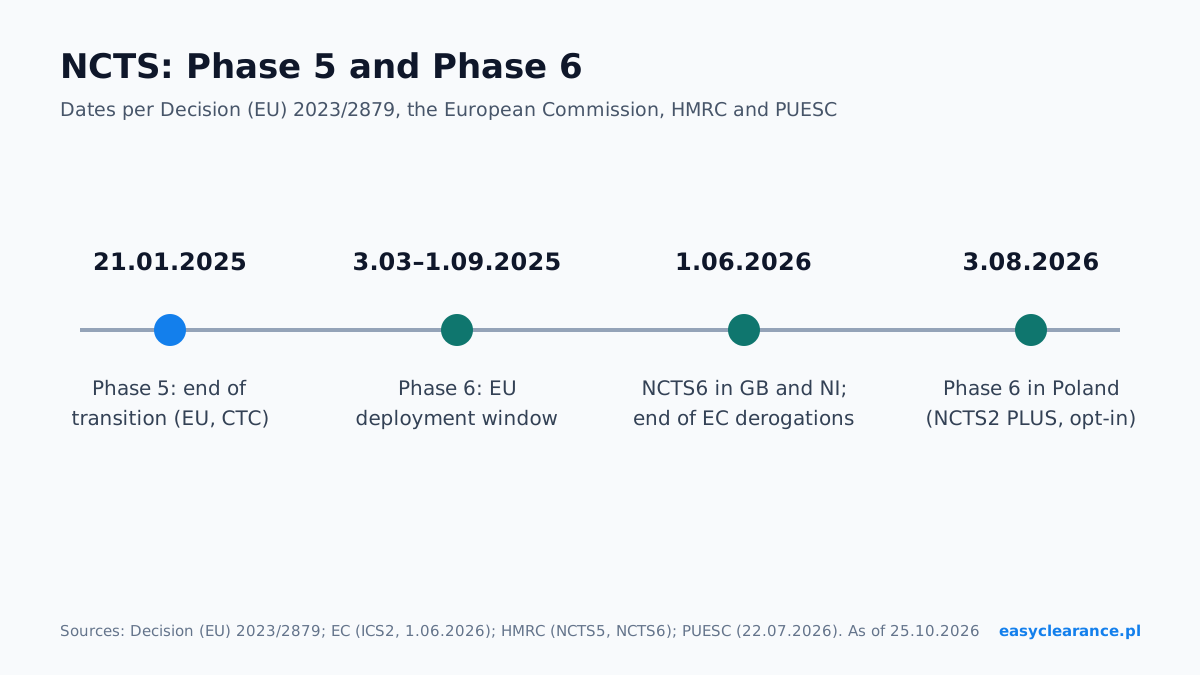
NCTS Phase 6 (NCTS-P6) is the second stage of the NCTS transit system upgrade in the Union Customs Code work programme. Its purpose is to connect NCTS with the ICS2 import control system, so that in countries that choose this option a transit declaration can carry entry summary declaration (ENS) data. In the EU the Phase 6 deployment window fell in 2025, and the temporary derogations ended on 1 June 2026. HMRC launched NCTS6 for Great Britain and Northern Ireland on 1 June 2026 (as an opt-out country), and Poland on 3 August 2026 (opt-in). We explain what this means for UK↔EU transit, based only on European Commission, HMRC and Polish customs (PUESC) documents.
Key points
- Phase 6 = “component 2” of the NCTS upgrade project (Commission Implementing Decision (EU) 2023/2879): safety and security data in transit declarations and an interface with ICS2.
- Each country chooses: opt-in (ENS data in a combined transit declaration) or opt-out (a separate ENS in ICS2).
- Poland has been running the opt-in variant since 3.08.2026, but the combined declaration is not mandatory.
- Great Britain (with Northern Ireland) is an opt-out country: from 1.06.2026 the IE015/IE013 transit declaration cannot carry ENS data.
- Phase 6 is not an integration with the AES export system — the AES interface belonged to Phase 5.
What is NCTS Phase 6 according to the European Commission?
The UCC work programme (Commission Implementing Decision (EU) 2023/2879, project 9 “UCC NCTS upgrade”) splits the NCTS upgrade into two components. Component 1 is Phase 5: aligning NCTS with UCC data requirements, without safety and security data. Component 2 is Phase 6, which implements the new safety and security data requirements, arising from the ICS2 project, for transit declarations of goods brought into the customs territory of the Union. This includes building the interface with ICS2 so that a transit declaration containing the particulars of an entry summary declaration can be lodged.
The work programme refers here to Article 130(1) UCC: customs may waive the lodging of an ENS if, before the time limit, a customs declaration containing at least the ENS particulars has been lodged. In Phase 6 that declaration can be a transit declaration. Phase 6 is therefore about the data flow between NCTS and ENS and ICS2, not about exports. The work programme places the NCTS interface with the AES export system in Phase 5.
Phase 6 timeline in the EU
| Stage | Date | Source |
|---|---|---|
| Phase 6 deployment window (component 2) | 3.03.2025 – 1.09.2025 | Decision (EU) 2023/2879, project 9 |
| ICS2 Release 3 window (road and rail) | 1.04.2025 – 1.09.2025 | Commission guidance, Ares(2025)1908172 |
| End of temporary derogations for Phase 6 and the link with ENS filing in ICS2 | 1.06.2026 | European Commission, ICS2 page |
The Commission’s guidance of 10 March 2025 gives 1 March 2025 as the start of the Phase 6 window, while Decision 2023/2879 gives 3 March 2025. Both documents give the same end date: 1 September 2025. According to the guidance, the national authorities of all EU Member States and of the CTC contracting parties were required to deploy Phase 6 within that window.
The Commission states that from 1 June 2026 every consignment entering EU territory, by any means of transport, should have a valid ENS. It can be submitted directly to ICS2 or, in opt-in countries, filed in the combined transit declaration through NCTS Phase 6.
Opt-in or opt-out — the two Phase 6 variants
The Commission’s guidance provides for two variants at national level:
- Opt-out — NCTS changes are minimal, and the transit movement must be covered by a separate ENS lodged in ICS2.
- Opt-in — the administration interconnects NCTS Phase 6 with ICS2, so ENS data from the combined transit declaration reaches ICS2.
An opt-out country may move to opt-in later, including after 1 September 2025. Until the opt-in version is deployed, traders must lodge a separate ENS in ICS2. The Commission publishes each country’s status in its “State of play NCTS-P6” overview.
Phase 6 in Poland (NCTS2 PLUS)
According to PUESC, Phase 6 integrates NCTS and ICS2 for safety and security data lodged in a single transit declaration. Poland is an opt-in country.
- Date: 1 June 2026 was the original plan. Phase 6 went live on 3 August 2026 at 00:00; after the go-live PUESC published notices about declaration errors.
- Scope: the integration covers PDS data only, not WDS data, and applies to road and rail transport.
- Optional: the combined declaration is not mandatory. You can lodge a transit declaration without safety and security data and a separate PDS in ICS2.
- Never both routes: in a notice dated 12 August 2026 PUESC reminds traders that safety and security data go either in the combined declaration or in ICS2. Data must not be altered just to pass validation in both systems.
- New messages: IEA15, IEA13 and IEA29 replace IE015, IE013 and IE029. As a rule one transit MRN corresponds to one PDS; several PDS MRNs are allowed for re-entry, where there is more than one office of first entry.
- EORI: in the safety and security data, the identification number of the holder of the procedure, the representative, the carrier and any additional supply chain actor must be an EORI number; the consignor and consignee may use an EORI or a TCUIN.
- Transport document numbers: they must be unique within the declaration, including at consignment level.
PUESC publishes the current Phase 6 XML specification on its NCTS2 page (version 2.14 as of October 2026).
Phase 6 in the UK — what HMRC announced and delivered
HMRC’s NCTS6 impact assessment states: “NCTS6 will go live on 1 June 2026 for NI and GB”. In its July 2026 transformation roadmap update HMRC confirmed that the new version was delivered on 1 June 2026. According to HMRC, the project is driven by Common Transit Convention obligations; the change does not alter how customers use the system but ensures compliance with EU technical requirements. Users still need to understand new functionality, such as changes to required data and new messages.
- Software: version 3.0 of the CTC Traders API (marked as beta) supports only Phase 6, and version 2.1 is marked as deprecated.
- No ENS in transit from GB: under UK-specific rule GB002 (XI002 for Northern Ireland), from 1 June 2026 IE015 and IE013 declarations cannot include ENS data. Only values 0 (not used for safety and security) and 2 (EXS data) are allowed; values 1 (ENS) and 3 (EXS+ENS) are no longer accepted.
- Where to find details: the NCTS guidance on GOV.UK still describes Phase 5 and lists no Phase 6 changes. HMRC publishes the Phase 6 technical specification (message types, rules, code lists) on the HMRC Developer Hub.
According to the Commission’s “State of play NCTS-P6” overview and the PUESC presentation of 15 May 2026, Great Britain (with Northern Ireland) is an opt-out country. This is consistent with rule GB002: a transit declaration lodged in GB does not carry ENS data.
What Phase 6 means for UK↔EU hauliers and forwarders
Transit opened in GB and entering the EU
Great Britain is an opt-out country, and since 1 June 2026 a transit declaration lodged in GB cannot carry ENS data (rule GB002). Under the Commission’s guidance, in the opt-out variant the transit movement must be covered by a separate ENS. For a T1 from the UK to the EU, the ENS is therefore lodged separately in ICS2.
Transit opened in the EU and travelling to GB
When entering GB through GVMS ports, the GMR must hold all transit MRNs from NCTS, without import declaration references. Adding the ENS MRN for GB is optional. The GB ENS itself is submitted through the S&S GB service, and the carrier is responsible for making sure it is submitted.
Transit opened in Poland
If goods enter the EU and transit starts in Poland, you can lodge either a combined declaration with PDS data or a separate PDS in ICS2 — never both. The declaration uses IEA15/IEA13 messages, and the identification data in the safety and security part require an EORI.
Checklist
- Check that your software supports Phase 6: IEA messages in Poland, CTC Traders API v3.0 in GB.
- Agree who lodges the EU ENS and the GB ENS, and do not duplicate safety and security data.
- Make sure transport document numbers are unique within the declaration.
- Put all transit MRNs in the GMR before check-in at a GVMS port.
A customs agency can lodge the transit declaration for you — see our T1/T2 transit service. Costs are on the pricing page.
Official sources
- Commission Implementing Decision (EU) 2023/2879 — UCC work programme, project 9, component 2 “NCTS-Phase 6”: EUR-Lex
- Regulation (EU) No 952/2013 (UCC), Article 130: EUR-Lex
- European Commission, guidance on the start of the deployment windows of ICS2 Release 3 (entry summary declarations and transit declarations for road and rail transport) and NCTS-P6, Ares(2025)1908172 of 10.03.2025: taxation-customs.ec.europa.eu
- European Commission, Import Control System 2 (news of 1.06.2026): taxation-customs.ec.europa.eu
- DG TAXUD, NCTS system page and the “NCTS-P6 – State of Play” overview: taxation-customs.ec.europa.eu
- HMRC, New Computerised Transit System (NCTS) 6 — equality impact assessment: GOV.UK
- HMRC, Transformation roadmap progress update 2026 — annex: GOV.UK
- HMRC Developer Hub, CTC Traders API 3.0: developer.service.hmrc.gov.uk
- HMRC Developer Hub, UK Specific Rules (GB002): developer.service.hmrc.gov.uk
- GOV.UK, Create a goods movement reference: GOV.UK
- GOV.UK, Making an entry summary declaration: GOV.UK
- PUESC, NCTS2 PLUS Phase 6 — ICS2 webinar slides, 15.05.2026 (Polish): puesc.gov.pl
- PUESC, NCTS2 PLUS Phase 6 FAQ, 15.04.2026 (Polish): puesc.gov.pl
- PUESC, news on the Phase 6 go-live (22.07.2026, 12.08.2026; Polish): puesc.gov.pl
Law and sources checked on 25.10.2026.
FAQ
What is NCTS Phase 6? It is component 2 of the NCTS upgrade project in the UCC work programme (Decision (EU) 2023/2879): safety and security data requirements in transit declarations of goods brought into the EU and an interface with ICS2 that allows a transit declaration containing ENS data to be lodged.
When did Phase 6 take effect? In the EU the deployment window ran from 3 March to 1 September 2025 (the Commission guidance gives 1 March as the start), and the temporary derogations ended on 1 June 2026. NCTS6 has been live in GB and NI since 1 June 2026; Poland went live on 3 August 2026 (originally planned for 1 June).
Do I have to lodge a combined declaration with ENS data in Phase 6? No. In Poland (an opt-in country) the combined declaration is optional: safety and security data go either in the transit declaration or separately as a PDS in ICS2 — never both. In opt-out countries a separate ENS in ICS2 is required.
Can a transit declaration lodged in GB carry an EU ENS? No. Great Britain is an opt-out country (Commission “State of play NCTS-P6”, PUESC), and under HMRC rule GB002, from 1 June 2026 IE015 and IE013 declarations in GB cannot include ENS data. In the opt-out variant a transit movement into the EU must be covered by a separate ENS lodged in ICS2.
Is Phase 6 an integration of NCTS with AES? No. According to the UCC work programme Phase 6 concerns ICS2. The harmonised interface between NCTS and the AES export system belonged to Phase 5.
Disclaimer: The information on this page is operational and informational in nature and does not constitute legal or tax advice. Correct as of the update date — customs rules and systems may change.
Have a similar case?
Send us 3 details: commodity, route, Incoterm — we will come back with the right clearance route. We respond 24/7.