ATA Carnet for UK–EU Movements: When Can It Be Used?
An ATA Carnet is one option for eligible temporary movements of goods, such as exhibition items or professional equipment. Confirm the accepted purpose, countries and return conditions before choosing the procedure.
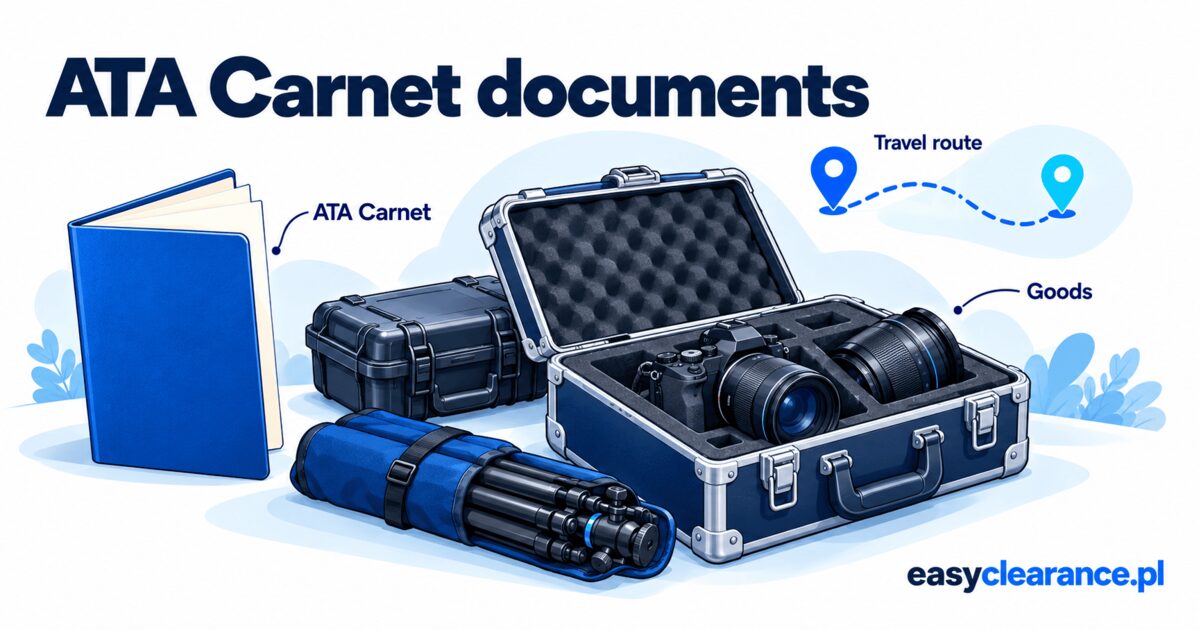
ATA Carnets
Options depend on the goods, purpose and route
Author
easyclearance.pl teamUpdated
15 October 2026
Quick definition
An ATA Carnet is one option for eligible temporary movements of goods, such as exhibition items or professional equipment. Confirm the accepted purpose, countries and return conditions before choosing the procedure.
Operational context
An ATA Carnet is an option for certain goods intended to return after temporary use. It is not automatically required for every UK–EU movement. Eligibility depends on the goods, their use and the countries visited.
Need operational support?
Describe the goods, purpose, route and dates, and ask whether support is available for the proposed movement.
Keep the goods list, purpose of use and route details consistent. Mismatches in model names, serial numbers or quantities can lead to queries about the goods being moved.
For urgent moves, run a short pre-check before document submission: purpose, goods traceability, signatory authority and return plan.
Checklist
- Define scope and purpose of temporary movement.
- Prepare complete goods list with identifiers.
- Align route, dates and return assumptions.
- Validate signatory authority and contact points.
ATA Carnet information · Contact now
Using the official guidance
Check the requirements for the exporting, transit and importing territories and for the return journey. HMRC describes UK application and use; KIG provides Polish issuer guidance. Confirm the applicable procedure, any declaration or relief conditions, and separate licensing requirements for the actual goods and route.
Operational watch-outs
Inconsistent invoice, packing, classification, reference or transport data can raise questions where those records are relevant. Before departure, agree who handles the customs formalities, check the information required for the chosen procedure and confirm any filing or presentation timing.
Documents and data to prepare
Start with goods identification, purpose and route details. Ask the issuer or representative which additional records are needed for the proposed movement; a temporary movement is not necessarily a sale. Useful items to check include:
- an invoice or other valuation record, where needed, with a clear goods description
- packing information with quantities, weight and package count, and any packing list required for the shipment
- any classification code and origin information required for the route and procedure; ask whether HS or a local tariff code such as the EU Combined Nomenclature (CN) is relevant
- holder and representative details, the party handling customs formalities, and confirmation of whether an EORI number or a separate declaration is needed
- a goods list with quantities, weights, values and identifying details such as make, model and serial numbers; where no serial exists, follow the issuer’s identification instructions, and state the temporary purpose
Practical notes for UK-PL operators
For regular movements, a reusable template may help keep the information consistent: goods description, any relevant classification and origin data, applicable Incoterms, carrier details and supporting records. Adapt it to the chosen procedure and itinerary; using a template does not guarantee quicker clearance or fewer corrections.
ATA Carnet questions
When can an ATA Carnet be used for UK–EU movements?
An ATA Carnet is one option for eligible temporary movements, such as fairs and exhibitions, commercial samples for demonstration, and professional equipment such as cameras or tools. The goods, purpose and countries visited must be covered; return intent alone is not enough. It is not compulsory for every temporary movement or limited to private, non-commercial activity. It is not the procedure for goods intended for permanent export. KIG excludes goods sent for processing or repair; HMRC also excludes those uses for UK temporary exports, apart from routine maintenance to keep goods in their original condition. Plan re-export and return within the carnet’s validity and any shorter time limit set by customs, with the required customs validation and evidence of return.
Can an ATA Carnet be used between the UK and Poland after Brexit?
Yes, for movements that meet the relevant conditions. The WCO lists the UK and EU states, including Poland, in its ATA system guidance, and KIG lists the UK among ATA destinations. KIG handles Polish carnet applications; UK applications go through an authorised issuing chamber. A Polish-issued carnet can be used for an eligible temporary movement to the UK, and a UK-issued carnet for an eligible movement to Poland, subject to local acceptance of the goods and purpose. The ATA/Istanbul framework does not remove those conditions. Confirm the issuer’s route instructions and current digital or paper handling before departure; Great Britain and Northern Ireland may involve different formalities.
What is the alternative to an ATA Carnet for a temporary movement?
The destination’s Temporary Admission procedure may be an alternative, using its own authorisation or declaration and security where required. For UK Temporary Admission, HMRC describes security such as a cash deposit or an undertaking from a bank or insurer; the requirement depends on the authorisation and territory. For a UK-to-Poland journey, confirm the EU/Polish temporary-admission and return formalities with the relevant customs authority. Compare carnet issuing and security charges with declaration costs, any funds tied up in a deposit or guarantee, and administration for the actual itinerary. A carnet can simplify eligible movements, but neither option is always cheaper, faster or more convenient for professional equipment or fair exhibits.
Official and issuer guidance
- GOV.UK: apply for an ATA Carnet — HMRC guidance, page updated 1 June 2026
- GOV.UK: how to use your ATA Carnet — HMRC guidance, page updated 1 June 2026
- HMRC: general list of goods — guidance, page updated 1 June 2026
- HMRC: ATA eligibility and scope — guidance, page updated 1 June 2026
- KIG: Polish ATA Carnet applications, scope and country list — issuer guidance
- WCO: the ATA system — system and transition guidance
- HMRC: Temporary Admission guarantees — guidance, manual updated 22 May 2026
- GOV.UK: taking goods temporarily out of Great Britain — guidance
Ask about clearance support
Describe the proposed movement and ask what support is available for the goods and route.