ATA Carnet documents and procedure step by step
Good planning prevents delays at border touchpoints. ATA Carnet is typically used for temporary movement of goods, especially when items must return after use. The key to smooth handling is consistency between goods list, shipment context and route assumptions.
Status
verified against official sources
Author
easyclearance.pl teamPublished
18 February 2026
Updated
4 March 2026
Quick definition
Good planning prevents delays at border touchpoints. ATA Carnet is typically used for temporary movement of goods, especially when items must return after use. The key to smooth handling is consistency between goods list, shipment context and route assumptions.
Operational context
ATA Carnet is typically used for temporary movement of goods, especially when items must return after use. Good planning prevents delays at border touchpoints.
Need operational support?
Send a quick brief and get a clear next-step plan.
The key to smooth handling is consistency between goods list, shipment context and route assumptions. Most rework comes from simple mismatches in model names, serials or quantities.
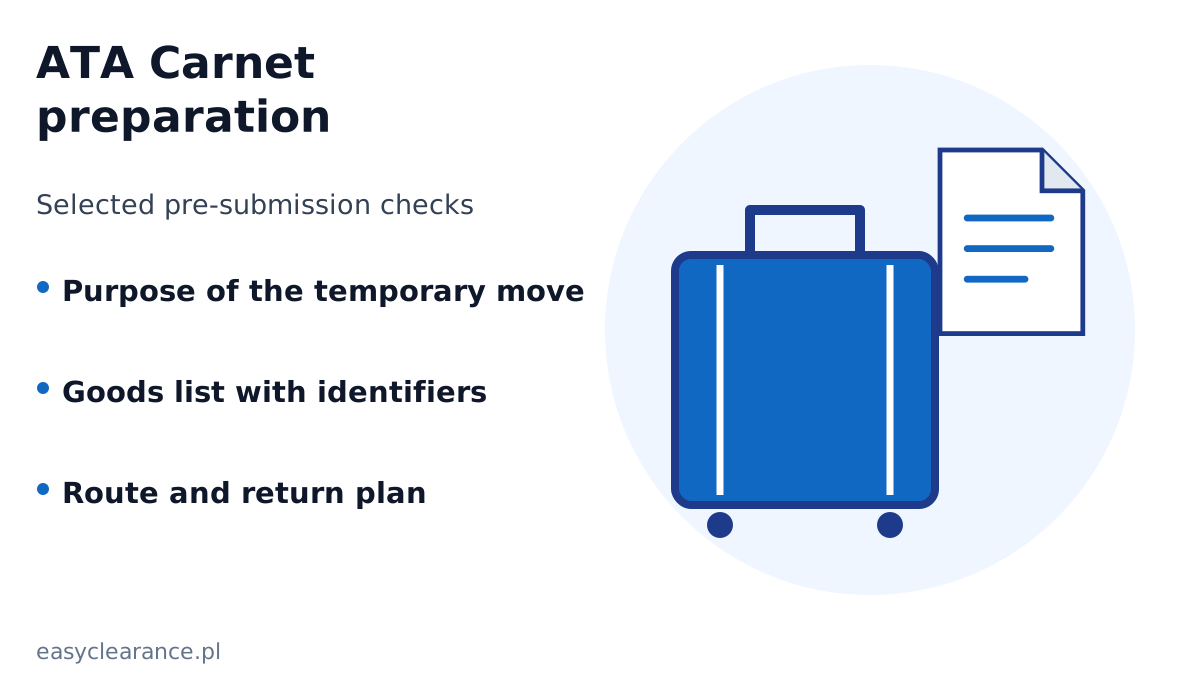
For urgent moves, run a short pre-check before document submission: purpose, goods traceability, signatory authority and return plan.
Checklist
- Define scope and purpose of temporary movement.
- Prepare complete goods list with identifiers.
- Align route, dates and return assumptions.
- Validate signatory authority and contact points.
Go to ATA service page · Contact now
What the current official guidance means in practice
According to GOV.UK guidance, an ATA Carnet replaces the customs documents you would normally complete when clearing goods in the exporting and importing countries. You must intend to bring the goods back to the UK, and you cannot process or repair them abroad, except for routine maintenance. Licensing controls and the rules for restricted or prohibited goods still apply.
Step by step: applying for a carnet
- Apply to one of the Chambers of Commerce listed by the UK National ATA Carnet Organisation, either as the carnet holder or as a representative.
- Give detailed descriptions so customs can identify the goods (photographs can be included), list the countries the goods will visit and pass through in transit, describe how the goods will be used and state the number of consignments in which they will return to the UK.
- The issuing office tells you whether it can issue the carnet, how much to pay, the guarantee or security required and when the carnet will be ready.
- You may receive a digital carnet (a PIN and a download in the ATA Carnet app) or a paper carnet; for a paper carnet, check that the green front cover has been stamped by a customs official at the issuing office.
Step by step: using the carnet
- Show the carnet to customs every time the goods are exported or imported, including on arrival in and departure from the country visited. The holder is responsible for making sure a digital carnet is scanned or a paper carnet is stamped.
- Digital carnet: before each movement, create a "travel" in the app by selecting the goods from the general list, and sync the app regularly.
- Paper carnet: on export from the UK customs keep the yellow export voucher (complete box F beforehand); in the country visited they keep the white import and re-export vouchers; on re-import into the UK they keep the yellow re-import voucher (you complete box F; one voucher per consignment). In some countries the carnet is also used as a transit document (blue voucher).
- Goods moved as freight may also need to be included on form C21e (export) or C21i (re-import) in the Customs Declaration Service.
Operational watch-outs
According to GOV.UK, if the descriptions on the carnet are not clear, the importing customs authority can refuse the carnet or delay releasing the goods until a declaration is made. If the carnet is not scanned or stamped on import or export, or the goods description is changed after the carnet is issued, you may have to pay Customs Duty, taxes and a penalty. The carnet holder is responsible for any charges if the goods are not re-exported from the country visited.
Documents and data to prepare
Information GOV.UK says the carnet application and use require:
- a detailed description of each item that allows it to be identified (for example model, serial number, quantity), optionally with photographs, for the carnet general list
- the countries the goods will visit and pass through in transit, and how the goods will be used
- the number of consignments in which the goods will return to the UK
- the guarantee or security set by the issuing office
- a reference to any licence or CITES document the goods need (for a paper carnet, on the back of the green cover sheet and the general list for each voucher)
Practical notes for UK-PL operators
For regular flows, keep a stable data template: goods description, HS code, origin, Incoterms, carrier details and source documents. This shortens response time and reduces border corrections.
Official sources
- GOV.UK: apply for an ATA Carnet — GOV.UK / HMRC, 2026-03-04
- GOV.UK: how to use your ATA Carnet — GOV.UK / HMRC, 2026-03-04