Cabotage in the UK after Brexit – how many trips you can make and when you break the law
UK cabotage rules after Brexit – maximum 2 runs in 7 days, what documents prove legality, penalties for illegal cabotage, and how DVSA checks foreign hauliers.
Author
easyclearance.pl teamPublished
2026-04-20
Updated
2026-06-11
Cabotage is one of the most misunderstood rules in international road transport — and one of the most frequently enforced since Brexit. If you are an EU carrier making domestic runs inside the UK after delivering a load from the continent, you need to know exactly how many trips you can legally make and within what time window. Getting it wrong costs up to £300 per illegal run, and DVSA is not lenient.
What is cabotage — definition in the UK
Cabotage is the commercial carriage of goods that is purely domestic, carried out by a haulier registered abroad, on the territory of another country.
In the UK context: cabotage occurs when an EU-licensed carrier, after delivering a load from the continent to the UK, makes additional runs within the UK — before returning to the continent. The run starts and ends on UK soil, without crossing the border.
Cabotage is NOT: - Transit through the UK (without stopping with a load), - Cross-border carriage to/from the UK from Europe (that is international trade, not cabotage), - Own-account transport (not for hire or reward).
Cabotage rules after Brexit — changes compared with the pre-2021 position
Before Brexit, EU carriers in the UK could rely on the Community cabotage regulation (1072/2009/EC): 3 cabotage runs within 7 days of delivering a load from the EU.
After Brexit (from 1 January 2021) the UK introduced its own, stricter rules:
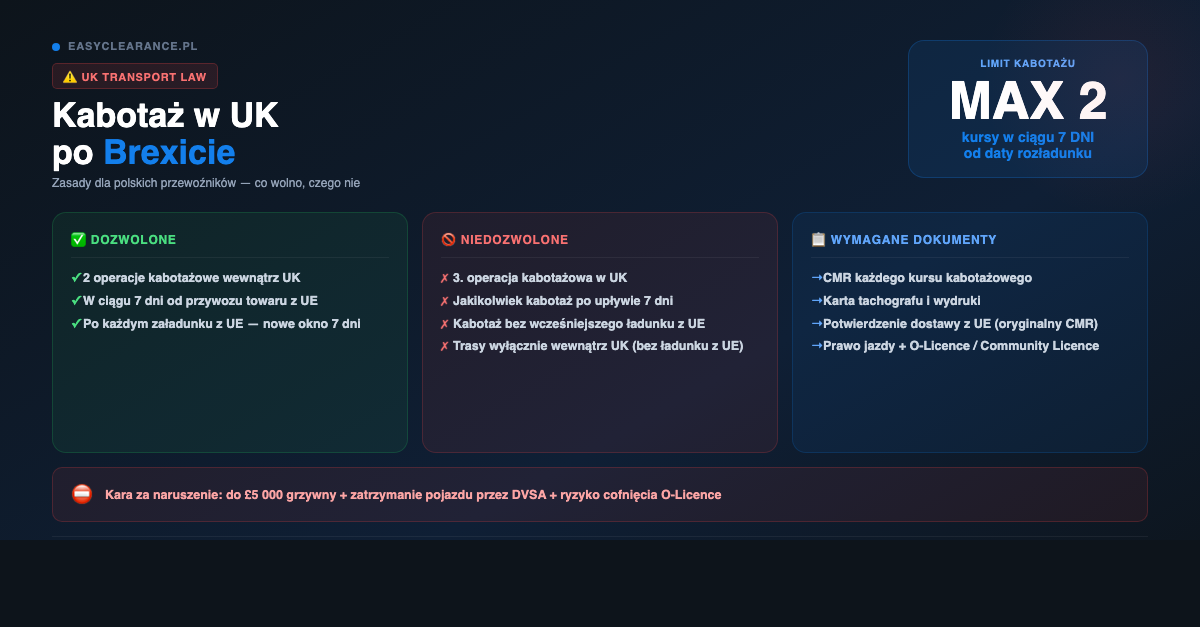
EU carriers may make a maximum of 2 cabotage runs within 7 days of delivering a load from the continent.
Summary of changes:
| Parameter | Before Brexit (EU rules) | After Brexit (UK rules) |
|---|---|---|
| Permitted cabotage runs | 3 runs | 2 runs |
| Time window | 7 days from delivery | 7 days from delivery |
| Vehicles covered | >3.5 t GVW | >2.5 t GVW (from 2022) |
| Legal basis | Reg. 1072/2009/EC | UK Domestic Regulation |
The key change: the UK also lowered the weight threshold — cabotage now covers vans from 2.5 t GVW, not just vehicles over 3.5 t.
How to count the 7 days and 2 runs — practical examples
The 7-day window starts from the moment of delivery of the load brought from the EU (date and time confirmed on the CMR).
Legal example: - Mon 08:00: delivery from Germany to Birmingham → load unloaded - Tue 10:00: run Manchester → Leeds (run 1 of 2) ✓ - Thu 14:00: run Bristol → London (run 2 of 2) ✓ - Sun 09:00: departure from the UK to France ✓
Illegal example: - Mon 08:00: delivery from Germany to Birmingham - Tue 10:00: run Manchester → Leeds (run 1) ✓ - Thu 14:00: run Bristol → London (run 2) ✓ - Fri 09:00: run Leeds → Sheffield (run 3) ✗ — third run within the 7-day window
Important: if you return to the continent and re-enter the UK with a load from the EU, the 7-day clock resets and you may make a further 2 runs.
Combined Transport — an exception to the cabotage rules
There is one significant exception: Combined Transport (intermodal transport). If your journey involves intermodal transport — for example, the vehicle travels by ferry or rail for part of the route — the cabotage rules may be modified.
In the UK, Combined Transport is regulated separately and may permit additional road legs accompanying a rail or sea leg. However, the rules are complex and require detailed verification before each run — a mistaken interpretation is not a mitigating factor during an inspection.
Documents proving the legality of cabotage
The driver must be able to demonstrate the legality of the cabotage operation during a DVSA roadside check or at the border. Required documents:
| Document | What it must contain | Purpose |
|---|---|---|
| CMR (consignment note) | Date, EU loading point, UK delivery point, parties, cargo | Proof of delivery from the EU and start of the 7-day window |
| Manifests for cabotage runs | Date, route, cargo, consignor, consignee for each domestic run | Proof of the number and sequence of runs |
| Invoice or transport order | Confirmation of the commercial nature of the cabotage | Proof that it is a paid-for carriage |
| Community Licence (ECMT or equivalent) | Valid international EU licence | Entitlement to carry out cabotage |
Documents must be with the driver during an inspection. Failure to produce a complete set of documents is treated as a presumption that the cabotage is illegal.
How DVSA checks cabotage — enforcement methods
DVSA (Driver and Vehicle Standards Agency) uses several verification methods:
On the road: - Random stops on motorways and at the border (especially near Dover and Folkestone), - Tachograph checks — routes, hours, breaks, - Verification of CMR documents and manifests, - Queries against the central carrier database.
At the border: - Border Force and DVSA jointly inspect vehicles entering and leaving, - ANPR (automatic number plate recognition) systems record vehicles at the border and can detect multiple entries and exits.
After the fact: - DVSA may initiate proceedings on the basis of tachograph data downloaded during an inspection, - Transport companies may be audited at their premises.
Penalties for illegal cabotage
Penalties are imposed on the driver and/or the transport company:
| Infringement | Penalty |
|---|---|
| Illegal cabotage run (per run) | Up to £300 |
| Failure to produce documents at inspection | Up to £300 |
| Serious and repeated infringements | Vehicle seizure, prohibition from entering the UK |
| Company infringements | Revocation of Community Licence, entry on DVSA register |
A fixed penalty notice can be issued on the spot — the driver must pay it or lodge a deposit before the vehicle is released.
Practical rules for compliant cabotage
- Always carry a complete CMR for the EU run — it is proof of the start of the 7-day window.
- Keep a separate manifest for each cabotage run showing the date, route, and cargo details.
- Reset your run count to zero after every return to the continent and re-entry with a load.
- Do not try to game "partial deliveries" — DVSA treats each separate domestic route as a separate run.
- Check that your Community Licence is valid before every departure to the UK.
FAQ — Cabotage in the UK after Brexit
How many cabotage runs can I make in the UK as a carrier from Poland? After Brexit: a maximum of 2 runs within 7 days of delivering a load from the EU to the UK. This is fewer than before Brexit (previously 3 runs were allowed).
Does cabotage apply to small vans under 3.5 tonnes? Yes — since 2022 the cabotage rules cover vehicles from 2.5 t GVW. A small van entering the UK with an EU load and making domestic runs is subject to the same rules as a heavy goods vehicle.
What happens if my driver does not have the CMR at an inspection? Absence of the CMR is treated as a lack of proof that the cabotage is lawful. DVSA may deem all domestic runs illegal and issue a fixed penalty for each. The vehicle may also be detained.
Can I make 2 cabotage runs, go back to France, and immediately return to the UK for a further 2? Yes — provided you bring a load from the EU each time. Every entry with a load resets the 7-day window and the 2-run limit.
Does carrying your own goods (not for hire or reward) also fall under the cabotage rules? No. Cabotage covers only commercial carriage of goods for hire or reward. A company transporting its own products in its own van is not carrying out cabotage within the meaning of the rules.
Customs clearance for EU carriers coming to the UK
Cabotage is just one legal aspect. Every load brought from the EU to the UK requires full customs clearance — an import declaration, MRN, and for sensitive goods also phytosanitary or veterinary certificates.
Easy Clearance specialises in customs clearance for carriers from Poland and other EU countries.
Get in touch: - WhatsApp: +44 7404 091503 - Tel: +44 7404 091503 - [LINK: Customs clearance for EU transport companies]
Fast response — we reply within 2 working hours.
The ranges quoted are indicative — an exact quote follows once documents are submitted. Import clearance: £45–£150.
Disclaimer: The information on this page is operational and informational in nature and does not constitute legal or tax advice. The price ranges quoted are indicative — an exact quote follows once documents are submitted.
Got a similar case?
Send us 3 pieces of information: goods, route, Incoterm — we will come back with the right clearance route. We respond 24/7.