Export Customs Clearance UK: Process, Documents and Declarations [2026]
Export customs clearance means making an electronic export declaration before goods leave the country, then having the exit confirmed. From Great Britain you declare in the Customs Declaration Service with a GB EORI number, yourself or through an agent. From the EU you lodge it in the Automated Export System. Keep the evidence, because it supports zero-rated VAT.
Status
verified against official sources
Author
easyclearance.pl teamPublished
18 February 2026
Updated
18 October 2026
Quick definition
Three things decide whether an export clears smoothly: a correct commodity code, an invoice that matches the goods, and a declaration filed in the right system before the vehicle reaches the port. Afterwards, keep the MRN and transport documents as proof of export.
If you would rather hand the filing over, see our export customs clearance service.
Exporting is not one filing but a sequence: check the rules for the goods, get the business ready, classify, invoice, declare, move the goods to the port and keep the evidence. This guide covers both directions that customers ask about: export clearance from Great Britain, handled in the UK Customs Declaration Service (CDS), and export from the EU to the UK, handled under the Union Customs Code.
Need operational support?
Send a quick brief and get a clear next-step plan. For fees, see the price list.
Export customs clearance procedure from Great Britain
GOV.UK describes the process as covering permanent moves of goods from Great Britain to countries outside the UK. In practice the steps run in this order:
- Check the rules for your goods. Confirm duties, restrictions and any licence requirements for the destination country. Animals, plants, medicines, chemicals, firearms and dual-use items can need licences or certificates (see our guide to dual-use goods).
- Get an EORI number. You need one starting with GB for England, Wales and Scotland.
- Decide who declares. Make the declaration yourself or appoint a customs agent.
- Classify the goods. Find the commodity code using GOV.UK's commodity code guidance.
- Prepare the invoice and documents. Invoice at the selling price or market value, obtain proof of origin if it is needed, and check whether you can zero-rate VAT.
- Make the export declaration and get the goods through customs.
- Keep records. Retain invoices and customs paperwork and record the goods in your VAT accounts.
For the EORI step, see when an EORI number is required.
Who makes the export declaration, and in which system
You can make export declarations yourself, which needs compatible software, or you can hire a transporter or customs agent. If you appoint an agent, GOV.UK says they cannot act without your written instructions, the instructions must state whether they act directly or indirectly, and the agent must be established in the UK for customs. You stay responsible for due diligence on your declarations, so check the data your agent files on your behalf.
For road exports to the EU the declaration is a combined safety and security and customs declaration, submitted in the Customs Declaration Service before the goods reach the departure port. It includes the vehicle registration number, obtained from your haulier. For unaccompanied trailers or containers, it includes the trailer or container number.
Export declaration by road: ports, GVMS and HMRC routes
Before filing, check whether your departure location needs an "arrived" export declaration or a pre-lodged one, and whether the port uses the Goods Vehicle Movement Service (GVMS). GOV.UK publishes a list of ports that use GVMS, and our GMR and GVMS guide explains how it works for hauliers.
After you file, HMRC assigns a route:
- Route 1: documentary checks. Email the export entry and supporting documents to the National Clearance Hub and wait for permission to proceed.
- Route 2: the goods go to a designated export place or authorised premises before clearance, and the documents go to the National Clearance Hub.
- Route 3: a post-departure documentary check.
- Route 6: permission to proceed to the port.
The goods must travel to the port or border location named in the declaration. If goods are held, typical reasons are missing licences, a failed inspection or being combined with a held shipment, and the National Clearance Hub can help. A rejected declaration is a separate problem: see CDS rejected declaration error codes.
Export documents: what the exporter and driver need
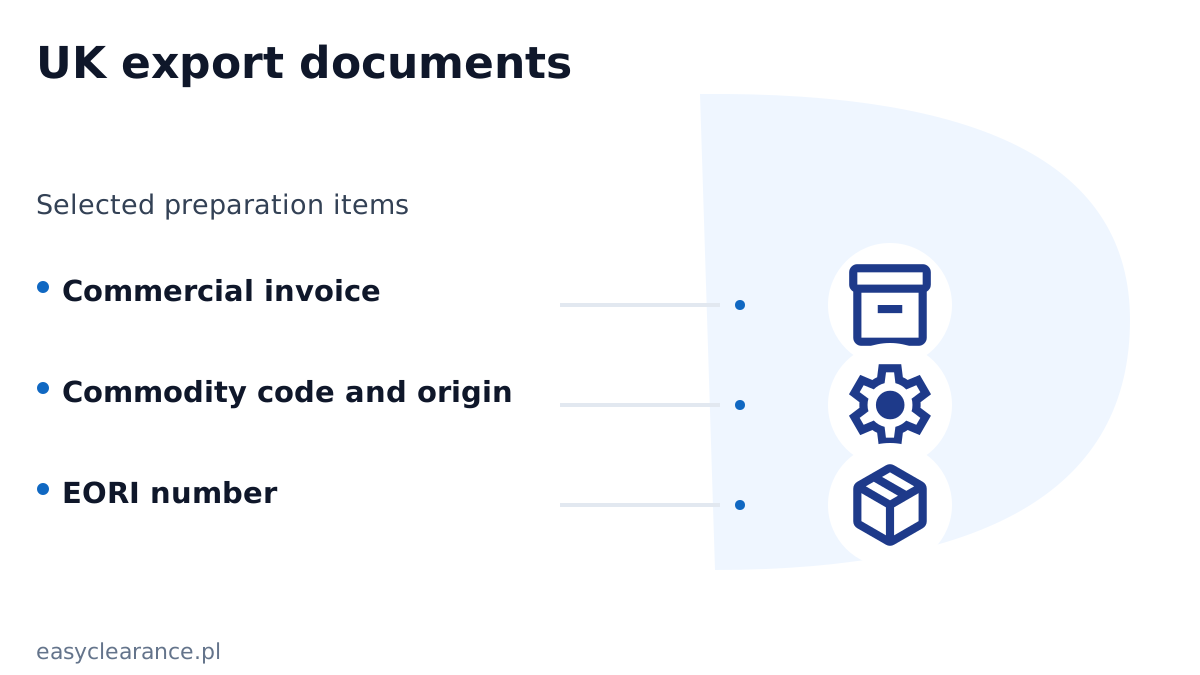
Prepare a consistent pack before the vehicle is loaded:
- commercial invoice with a complete goods description, at selling price or market value
- commodity code and origin information, plus proof of origin where it is needed
- your EORI number and the details of the party making the declaration
- export licences or certificates for controlled goods
- the road consignment note (CMR) for road transport
- the MRN from the export declaration, a copy of which the driver should carry
GOV.UK adds that goods moving under the Common Transit Convention need both the MRN and the Local Reference Number (LRN), and that temporary exports outside the EU need an ATA Carnet (see ATA Carnet for trade fairs and equipment). Weight, goods description and invoice values should agree across every document, as mismatches are a common cause of holds. A full list is in our export documents checklist, and invoice mistakes are covered in errors on the commercial invoice.
Simplified export declarations for regular exporters
If you do not have the full consignment details at the time of export, GOV.UK describes a two-part simplified declaration. You send basic goods details first and the remaining data in a supplementary declaration, using the same Declaration Unique Consignment Reference (DUCR) so that both parts link as one declaration. For the simplified declaration procedure, the supplementary declaration is due within 14 days of the goods leaving the UK; for multiple consignments, by the 10th calendar day of the month after export.
To use it you apply to HMRC on form C&E48. GOV.UK lists conditions including a good compliance record assessed over the three years before applying, a regular pattern of declarations against your EORI number, and keeping all declarations for at least four years.
Proof of export and 0% VAT
Zero-rating is not automatic. HMRC VAT Notice 703 requires that the goods are physically exported within the time limit and that you obtain and keep evidence of supply and of export. For direct and indirect exports the limits are 3 months to export and 3 months to obtain evidence of export, both counted from the time of supply. Where goods are processed or incorporated before export, the limit is 6 months for both. If a condition is not met, UK VAT is due at the appropriate rate.
- Official evidence: an export declaration in the Customs Declaration Service that has generated a departure confirmation, referenced by its MRN or DUCR.
- Commercial evidence: documents describing the physical movement, such as waybills, bills of lading and CMR consignment notes.
Evidence must give a clear audit trail from sale to export, and HMRC says to keep proof of export for 6 years. Ex-works (indirect) exports need a high standard of evidence, and copies of transport documents alone are not sufficient. If the exit confirmation is missing, read alternative proof of export.
Export customs clearance from the EU to the UK
For EU exporters the European Commission describes the export procedure as covering EU goods leaving the customs territory and notes it is obligatory with very few exceptions (Article 269 of the Union Customs Code). It has two stages, export and exit:
- Export declaration. The exporter or declarant lodges the declaration at the customs office responsible for where they are established or where the goods are packed or loaded. It must be electronic, through the Automated Export System (AES). An oral declaration is possible only in certain circumstances, and not for goods that are subject to prohibitions or restrictions.
- Release and exit. The office of export releases the goods after the required controls and sends the declaration particulars to the declared office of exit. The office of exit checks the goods against that information and supervises their physical departure. Goods remain under customs supervision until they leave the customs territory, and the office of exit informs the office of export of the exit.
The European Commission also notes a pre-departure (safety and security) requirement: carriers must provide advance information on goods to be exported, which can be satisfied by the export customs declaration itself. Because UK customs rules then apply on arrival, the importer or its agent must also file an import declaration in the UK; see how long customs clearance takes and who pays duty and VAT. Delivery terms decide who handles which side, so agree them in writing (see DDP, DAP and EXW). If the exit result for a UK export has not arrived, use our guide on what to do without IE599.
Exporting a parcel or small consignment
The same GOV.UK exporting guidance sends you elsewhere for some cases: goods sent by post follow Royal Mail guidance, a small amount of goods taken personally to sell abroad has its own page, and goods leaving temporarily follow the temporary export guidance. If you are unsure which route applies, send us the shipment details and we will tell you which declaration is needed.
Common mistakes that delay export clearance
- filing late, or in the wrong system for the port of departure
- a goods description, weight or value on the declaration that differs from the invoice or CMR
- a wrong commodity code
- giving the driver no MRN, or the wrong vehicle registration number on the declaration
- failing to keep exit evidence, which puts 0% VAT at risk
- appointing an agent without written instructions
Official sources
- GOV.UK: Export goods from the UK
- GOV.UK: Get UK customs clearance when exporting goods
- GOV.UK: Sending goods to the EU through RoRo ports or the Channel Tunnel
- GOV.UK: Transport goods from the UK by road
- GOV.UK: Appoint someone to deal with customs on your behalf
- GOV.UK: Using simplified declarations for exports
- HMRC: VAT on goods exported from the UK (Notice 703)
- GOV.UK: Get an EORI number
- European Commission: Exportation
Need help with clearance?
Our ops team will help with documents and process.
FAQ - Export customs clearance
What is export customs clearance?
It is the process of declaring goods to customs before they leave a country permanently, getting them released, and having their physical exit recorded. The declaration is made electronically. In Great Britain it is made in the Customs Declaration Service, and in the EU through the Automated Export System.
Do I need an EORI number to export from the UK?
Yes. GOV.UK says exports from England, Wales or Scotland need an EORI number starting with GB, and moves to or from Northern Ireland may need one starting with XI. You can apply through the GOV.UK EORI service.
Can a customs agent make my export declaration?
Yes. GOV.UK says you can make export declarations yourself or appoint someone to deal with customs for you. The agent needs your written instructions and must be established in the UK for customs. You remain responsible for due diligence on your declarations.
What is an MRN and why does the driver need it?
The Movement Reference Number (MRN) identifies the export declaration. GOV.UK says the driver needs a copy of the MRN from the export declaration, together with any export licences. Goods moving under Common Transit need both the MRN and the Local Reference Number (LRN).
How long do I have to prove export for 0% VAT?
For direct and indirect exports, HMRC VAT Notice 703 sets 3 months from the time of supply to export the goods and 3 months to obtain evidence of export. Where goods are processed or incorporated before export, the limit is 6 months for both.
What counts as proof of export?
Official evidence is an export declaration submitted to the Customs Declaration Service that has generated a departure confirmation, identified by its MRN or DUCR. Commercial evidence includes waybills, bills of lading and CMR consignment notes. HMRC says to keep proof of export for 6 years.
What is a simplified export declaration?
It is a two-part process. You submit basic goods details first, then a supplementary declaration with the rest. For the simplified declaration procedure the supplementary declaration is due within 14 days of the goods leaving the UK. You need HMRC authorisation, applied for on form C&E48.
Disclaimer: The information on the site is operational and informational in nature and does not constitute legal or tax advice.
Do you need support with this procedure?
Contact our operations team. We respond 24/7.