UK towing limits — weight and size rules for car and trailer combinations
UK towing limits — how to calculate the permitted trailer weight, MAM, kerbside weight, category B+E, speed limits when towing and penalties for exceeding limits. A practical guide.
Author
easyclearance.pl teamPublished
2026-04-20
Updated
2026-06-11
Many people towing a trailer on UK roads are unaware that they are breaking the rules — even with a relatively light caravan. In the UK, towing limits depend not only on the trailer itself but also on the year in which the driving licence was obtained, the unladen weight of the towing vehicle, and the maximum permissible weight of the combined outfit. One error in the calculation can result in a fine, the vehicle being immobilised, or the insurance policy being invalidated.
MAM, kerbside weight and GTW — three figures you must know
Before looking at the limits, it is essential to understand the key terms:
| Term | Definition | Where to find it |
|---|---|---|
| MAM (Maximum Authorised Mass) | The maximum permissible total weight of the trailer including its load | Trailer's plate, V5C |
| Kerbside weight | The unladen weight of the towing vehicle without driver, passengers or load, but with a full fuel tank | Manufacturer's documentation, V5C |
| GTW (Gross Train Weight) | The maximum total weight of the combined outfit (vehicle + trailer) | Towing vehicle documentation |
| Payload | The difference between the MAM and the trailer's unladen weight — how much you can load | Self-calculated |
The key rule: you must never exceed the GTW of the towing vehicle or the MAM of the trailer — whichever limit is lower applies.
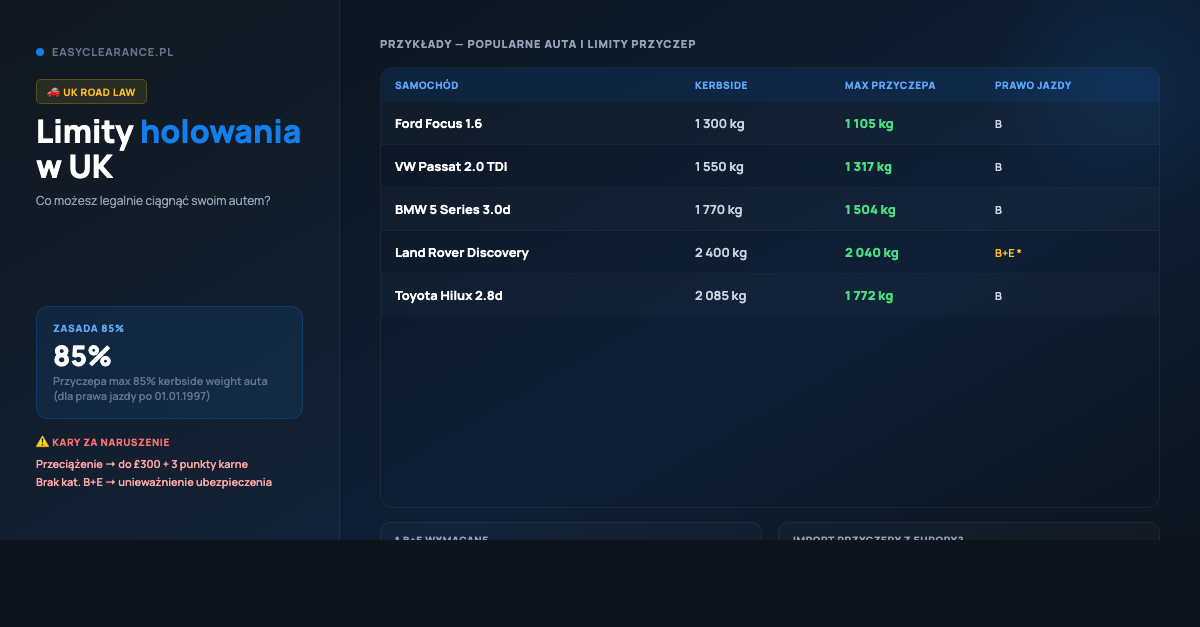
The 85% rule — for drivers who passed their test after 1997
If you obtained your category B licence after 1 January 1997, the so-called 85% rule applies to you:
The MAM of the trailer must not exceed 85% of the kerbside weight of the towing vehicle.
Example: your car has a kerbside weight of 1,800 kg. You may tow a trailer with a MAM of no more than 1,530 kg (85% of 1,800). Even if your vehicle's GTW is sufficient for a heavier trailer, your category B licence restricts you to this figure.
Note: this is a safety requirement embedded in licence conditions, not merely a guideline — exceeding it constitutes a breach of your licence entitlement and may invalidate your motor insurance policy.
Entitlement without the 85% restriction — licences obtained before 1997
Drivers who obtained their category B licence before 1 January 1997 have automatically extended entitlement. They may tow a trailer whose MAM equals the unladen weight of the towing vehicle (100%, not 85%) — provided that:
- The combined weight of the outfit (GTW) does not exceed 3,500 kg, and
- The trailer's weight does not exceed the unladen weight of the towing vehicle.
If the GTW of the outfit is to exceed 3,500 kg, a B+E entitlement is required regardless of when the licence was obtained.
Category B+E — when it is required
Category B+E is a licence extension that permits the towing of heavier trailers. It is required when:
- The MAM of the trailer exceeds 750 kg, and at the same time
- The GTW of the outfit (vehicle + trailer) exceeds 3,500 kg
Simply having a vehicle with a GTW above 3,500 kg is not sufficient — both conditions must be met simultaneously.
The B+E test in the UK comprises a theory test (if not already passed) and a practical test with a vehicle and trailer. The cost of a B+E course is typically £300–600 depending on the school and region.
Table — example towing limits for popular vehicles
| Vehicle | Kerbside weight | Max trailer (85%) | Max trailer (GTW) | Notes |
|---|---|---|---|---|
| Ford Focus (2022) | 1,385 kg | 1,177 kg | 1,500 kg | 85% limit applies |
| VW Transporter T6 | 2,050 kg | 1,742 kg | 2,500 kg | 85% limit applies |
| Land Rover Defender 110 | 2,360 kg | 2,006 kg | 3,500 kg | 85% limit applies |
| Toyota Hilux (2023) | 2,100 kg | 1,785 kg | 3,500 kg | 85% limit applies |
| BMW X5 xDrive30d | 2,185 kg | 1,857 kg | 2,700 kg | GTW limit applies |
Figures are indicative — always verify against the V5C and manufacturer's documentation.
Speed limits when towing in the UK
Towing a trailer changes the applicable speed limits — regardless of road signs:
| Road type | Without trailer | With trailer |
|---|---|---|
| Built-up area | 30 mph | 30 mph |
| Single carriageway | 60 mph | 50 mph |
| Dual carriageway | 70 mph | 60 mph |
| Motorway | 70 mph | 60 mph |
Exceeding the speed limit while towing is treated in the same way as a standard speeding offence — a fine and penalty points. If a laser camera or ANPR system identifies your vehicle as towing a trailer (for example, by detecting a trailer number plate), the lower limits are applied automatically.
Penalties for exceeding towing limits
The consequences can be severe:
- Fixed penalty notice: up to £300 and up to 3 penalty points for towing a trailer that exceeds your licence entitlement or the vehicle's GTW.
- Vehicle immobilisation: DVSA and the Police have the power to stop and immobilise your vehicle until it complies with the regulations (for example, until the trailer is unloaded).
- Insurance invalidation: most motor insurance policies exclude cover for damage arising from towing in excess of the permitted limit — this could mean full personal financial liability for an accident.
- Criminal liability: in cases of gross excess or where an accident occurs, criminal proceedings for dangerous driving are possible.
How to check the towing limit for your vehicle
Three reliable sources:
- V5C (logbook): the "Maximum permissible weights" section — you will find the GTW and GVW of your vehicle.
- Manufacturer's technical documentation: in the owner's manual or on the manufacturer's website (usually under "Towing" or "Specifications").
- VIN plate in the wheel arch or door sill: states the GTW of the vehicle and sometimes the maximum trailer weight.
If the V5C contains no towing data, contact the DVLA or the manufacturer — do not assume you can tow any trailer.
FAQ — UK towing limits
How much can I tow on a category B licence obtained in 2005? A maximum of 85% of the kerbside weight of your towing vehicle — provided the GTW of the outfit does not exceed 3,500 kg. If you need to tow a heavier load, you must pass the B+E test.
Does the towing limit depend on the towbar? Yes — the towbar has its own rating (e.g. 1,500 kg). You cannot tow a trailer heavier than the towbar's rating, even if the vehicle and your licence permit it. The towbar rating can be found in the fitting documents or on the towbar plate.
Can I tow a 1,800 kg caravan with an SUV weighing 2,000 kg? With a licence obtained after 1997: the 85% limit is 1,700 kg — 1,800 kg exceeds your entitlement. You must either reduce the caravan's laden weight or pass the B+E test.
What is noseweight and why does it matter? Noseweight (coupling downforce) is the vertical force exerted on the towball by the trailer. If it is too high, it causes instability at the rear axle of the towing vehicle; if it is too low, it causes trailer snaking (snaking). The permitted noseweight is given in the vehicle documentation — typically 50–150 kg.
Do the rules also apply to light trailers under 750 kg? Technically, a trailer with a MAM of up to 750 kg can be towed within category B without the 85% restriction, but the GTW of the outfit and the towing speed limits still apply.
Towing a trailer between the UK and EU? Check the customs requirements
If your trailer or its load crosses the UK–EU border, customs documents may be required: T1, CMR, an export or import declaration. Not every caravan is exempt — particularly if you are carrying commercial goods.
[LINK: How to clear a trailer carrying goods in UK-EU transport]
Have a question about customs documents when towing? - WhatsApp: +44 7404 091503 - Tel: +44 7404 091503
Quick response — we reply within 2 working hours.
Disclaimer: The information on this page is for general information purposes only and does not constitute legal or tax advice. The price ranges quoted are indicative — an exact quote will be provided once the relevant documents have been submitted.
Got a similar case?
Send us 3 details: goods, route, Incoterm — we will come back with the right clearance route. We respond 24/7.