Operator Licence for vans 2.5–3.5 tonnes travelling to the EU — what you need to know
Standard International Operator Licence for vans 2.5–3.5 t travelling to the EU. Who needs one, how to apply, CPC requirements, processing time and cost. Post-Brexit guide.
Author
easyclearance.pl teamPublished
2026-04-20
Updated
2026-06-11
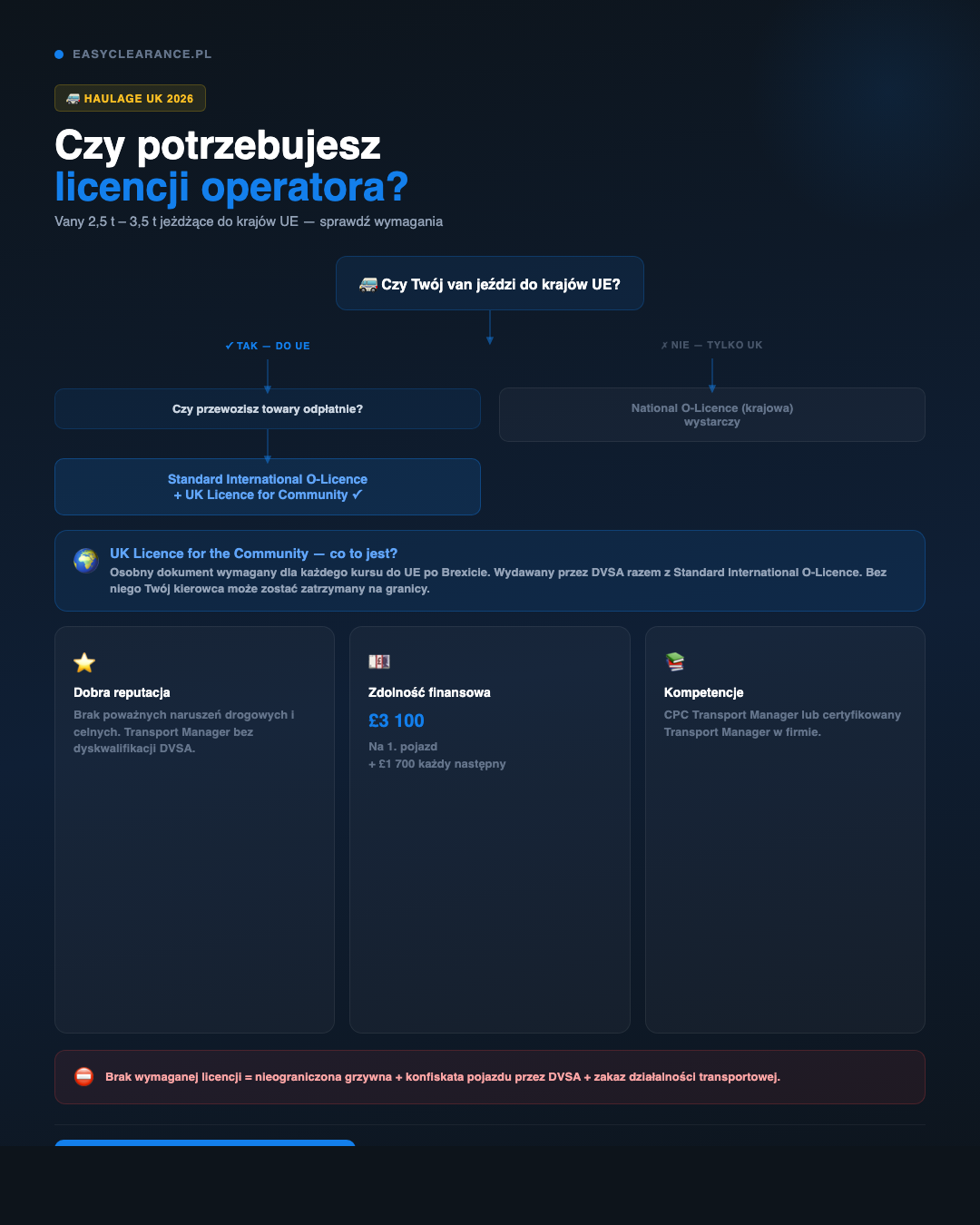
Before Brexit, Polish companies sending vans to the UK did not need to worry about operator licences on the British side. Since January 2021, the rules have changed dramatically — every UK carrier undertaking commercial road haulage to the EU in a vehicle over 2.5 t must hold a Standard International Operator Licence and a UK Licence for the Community. Not having these documents is not just a risk of a fine — it means a real possibility of the vehicle being detained at the border.
Who needs a licence? The scope of the requirement post-Brexit
The obligation to hold a Standard International O-Licence applies to any entity that:
- Carries out commercial road haulage of goods,
- Uses a vehicle or vehicle combination with a gross vehicle weight exceeding 2.5 t (from 21 May 2022 the threshold was lowered from 3.5 t to 2.5 t),
- Operates on routes to the EU or through the EU (even a single journey),
- The vehicle is registered in the UK.
The key point: even a single journey to the EU requires a licence. There is no exemption for small businesses, sole traders, or occasional haulage. This also applies to companies that have until now operated exclusively domestically and are only planning to expand into the European market.
Who does NOT need a licence: - Own-account transport (non-commercial) — e.g. a company transporting its own machinery in its own van, - Vehicles below 2.5 t GVW, - Taxis and buses (covered by separate legislation).
Standard International O-Licence vs Standard National O-Licence
Many operators confuse the two licence types. The difference is fundamental:
| Feature | Standard National | Standard International |
|---|---|---|
| Permitted routes | UK only | UK + EU countries and beyond |
| UK Licence for the Community | Not issued | Issued (required for EU travel) |
| Requirements | The same | The same |
| Application fee | ~£257 | ~£257 (same rate) |
If your company travels to the EU, you need a Standard International licence — a National licence is not sufficient. Holding an International licence automatically covers domestic haulage as well.
UK Licence for the Community — a separate document for every EU journey
The Standard International O-Licence is the foundation, but to physically enter the EU you also need a UK Licence for the Community (UKFLC). This is a document issued by the Traffic Commissioner on the basis of the O-Licence, which the driver must carry on every journey to the EU.
The UKFLC is issued: - For each vehicle in the fleet (or as certified copies), - For a period of up to 5 years, - It may be revoked along with the O-Licence if the conditions are breached.
Formal requirements — the three pillars of the O-Licence
Applications for a Standard International O-Licence are considered by the Traffic Commissioner in the region where the company is based (or has its principal place of business). To obtain the licence, you must satisfy three conditions:
1. Good Repute
The company and its director/owner must have an unblemished history — no serious criminal convictions, no previously revoked licences, no serious breaches of transport legislation. The Traffic Commissioner checks the record through DVSA and the police.
2. Financial Standing
You must demonstrate that you have sufficient financial resources to operate safely. Minimum requirements (2025):
- First vehicle: 8,000 EUR (or equivalent in GBP),
- Each additional vehicle: 4,500 EUR.
Funds can be evidenced by a bank statement (they must have been available for at least 28 days before the application is submitted), a credit facility, a bank guarantee, or an insurance policy.
3. Professional Competence
The company must hold or employ a Transport Manager with CPC qualifications (Certificate of Professional Competence in Road Haulage). The Transport Manager may be:
- The owner or director of the company (if they hold the CPC themselves),
- An employed member of staff (External Transport Manager),
- A person managing from outside — but only on condition that they do not manage more than 50 vehicles in total across all companies.
The Transport Manager CPC examination consists of 2 written modules: transport law and transport organisation. It is administered by OCR/CILT. Examination fee: approximately £260–400. EU-acquired qualifications may also be recognised — but this requires verification by the Traffic Commissioner.
How to apply — step by step
- Register on the DVSA platform: applications are submitted electronically via the GOV.UK Operator Licensing system.
- Complete the application form: provide company details, registered address, Transport Manager details, and the number and type of vehicles.
- Attach documents: proof of financial standing, Transport Manager details (CPC number), director details.
- Pay the application fee: approximately £257 (one-off). An additional annual fee per vehicle: ~£402/year (Continuation Fee).
- Public advertisement: the Traffic Commissioner may advertise your application in "Applications and Decisions" — neighbours and other parties may raise an objection within 21 days.
- Decision: the standard processing time is 3–6 months. In complex cases a public inquiry may be scheduled.
Processing time and what to do in the meantime
Waiting for a Traffic Commissioner decision typically takes 3–6 months — during this period it is not lawful to carry out commercial haulage to the EU. The exception: if you are applying as a continuation of operations following a takeover of a licensed company, an Interim Licence may be granted.
If you urgently need to complete a journey to the EU before your licence is granted, it may be possible to use a subcontractor with a valid licence — but this requires careful preparation of the contracts.
FAQ — Operator Licence for vans (UK)
Do I need a licence if I only drive my van to the EU a few times a year? Yes. There is no frequency threshold — even a single commercial journey in a vehicle over 2.5 t to the EU requires a Standard International O-Licence. Operating without a licence is a breach of the law regardless of how many journeys you make.
Can the owner of a small business act as their own Transport Manager? Yes — provided they hold a valid Transport Manager CPC certificate. An owner-driver may combine both roles. They must, however, satisfy the requirement of "continuous and effective management" of the transport operation.
What are the penalties for making journeys to the EU without a licence? A fine of up to £5,000, vehicle seizure, and a prohibition from operating transport services. DVSA and EU enforcement authorities conduct intensive compliance checks at the border and on the road.
Can I transfer a licence between companies or sell it? No. An O-Licence is non-transferable — it cannot be passed on or sold. A new business owner must submit their own application to the Traffic Commissioner.
How long is a Standard International O-Licence valid? The licence is granted for an indefinite period, but requires annual renewal (Continuation Fee ~£402/vehicle/year) and the ongoing maintenance of all requirements (financial standing, Transport Manager, good repute).
Is a licence obtained before Brexit still valid? If you held a Standard International O-Licence before 2021 and continue to meet the current requirements — it remains valid. However, cabotage rights and other rules for operating in the EU changed after Brexit.
Disclaimer: The information on this site is operational and informational in nature and does not constitute legal or tax advice. The price ranges given are indicative — an exact quote will follow once documents have been submitted.
Got a similar case?
Send us 3 details: goods, route, Incoterm — we will come back with the right clearance approach. We respond 24/7.