Customs penalties in the UK – amounts and reasons? [2026]
Clandestine entrants – a Home Office (not HMRC) penalty of up to £10,000 per responsible person per entrant. No declaration – "driving in without clearance." Confiscation of goods + excise (for alcohol) + 100% penalty of due amount.
Status
verified against official sources
Author
easyclearance.pl teamPublished
18 February 2026
Updated
4 March 2026
Quick definition
Clandestine entrants – a Home Office (not HMRC) penalty of up to £10,000 per responsible person per entrant. No declaration – "driving in without clearance." Confiscation of goods + excise (for alcohol) + 100% penalty of due amount. Penalty: £250 to £2,500 per error.
HMRC may impose so-called Civil Penalty for: 1. Misdeclaration – e.g. incorrect commodity code reducing duty. Penalty: £250 to £2,500 per error. 2. No declaration – "driving in without clearance." Confiscation of goods + excise (for alcohol) + 100% penalty of due amount.
Separately, outside the HMRC penalty regime: for carrying clandestine entrants the Home Office (Border Force) may impose a civil penalty under section 32 of the Immigration and Asylum Act 1999 – up to £10,000 per responsible person (driver, owner or hirer of the vehicle) per clandestine entrant (Level of Penalty: Code of Practice, 2023).
Need operational support?
Send a quick brief and get a clear next-step plan.
What the current official guidance means in practice
For operational work, the current procedural rules, declaration fields and relief conditions should be checked directly against the official guidance. For this topic, the core reference points are European Commission, GOV.UK / HMRC.
Operational watch-outs
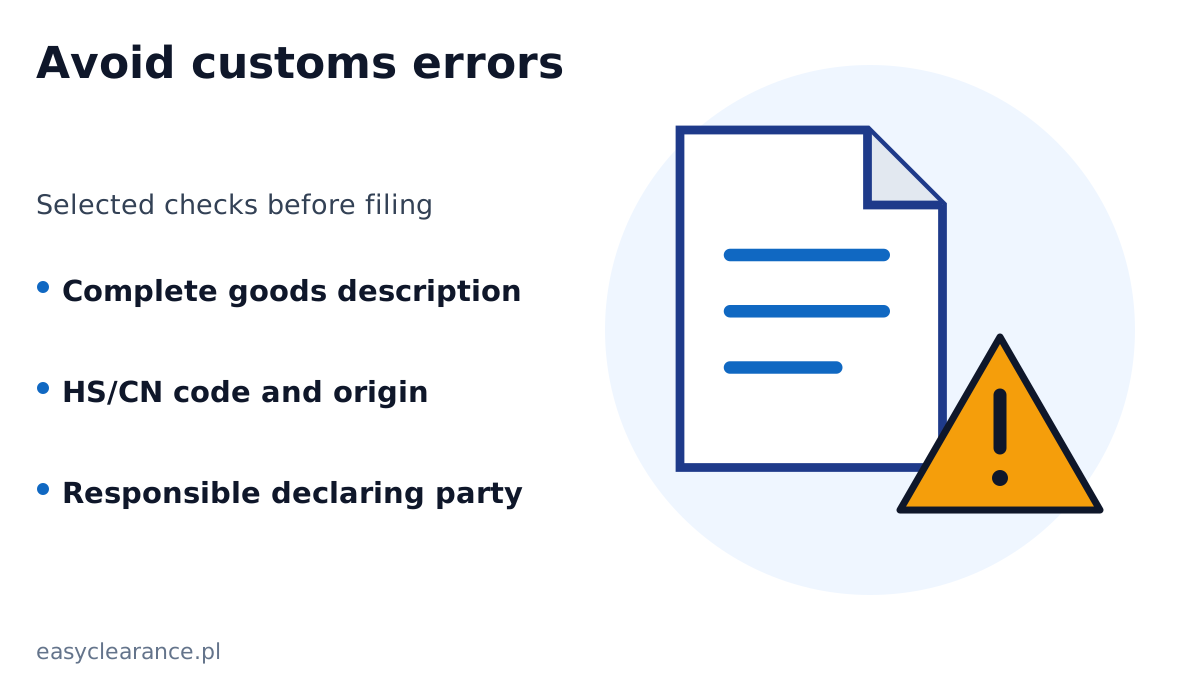
Most delays come from inconsistent data between the commercial invoice, packing list, tariff classification, reference numbers and transport assumptions. Before shipment release, confirm who is responsible for clearance, whether the data set is complete and when the declaration must be filed.
Documents and data to prepare
The minimum working pack worth preparing before speaking to customs support or filing a declaration includes:
- commercial invoice with a complete goods description
- packing list with quantities, weight and package count
- HS/CN code and origin information
- EORI number and the party responsible for the declaration
Practical notes for UK-PL operators
For regular flows, keep a stable data template: goods description, HS code, origin, Incoterms, carrier details and source documents. This shortens response time and reduces border corrections.
Official sources
- EU Commission (Customs procedures) — European Commission, 2026-03-04
- UK GOV (Importing into the UK) — GOV.UK / HMRC, 2026-03-04
- GOV.UK: Customs Declaration Service — GOV.UK / HMRC, 2026-03-04
Disclaimer: The information on the site is operational and informational in nature and does not constitute legal or tax advice.
Do you need support with this procedure?
Contact our operations team. We respond 24/7.