What is a Customs Guarantee? [2026]
If you want to suspend duty payment (e.g. in T1 transit or a customs warehouse) or defer it, you must provide financial security. This is the customs guarantee.
Status
verified against official sources
Author
easyclearance.pl teamPublished
18 February 2026
Updated
4 March 2026
Quick definition
A customs guarantee is financial security for customs debt. You need one if you want to suspend duty (e.g. in T1 transit or a customs warehouse) or defer it. In Great Britain, HMRC usually asks for a guarantee as a condition of approving a duty deferment account, and some businesses can get a waiver; import VAT can instead be accounted for with postponed VAT accounting, without a deferment account. A customs comprehensive guarantee (CCG) for duty deferment is required in Northern Ireland.
If you want to suspend duty payment (e.g. in T1 transit or customs warehouse) or defer it (deferred payment), you must submit financial security. This is the customs guarantee.
Need operational support?
Send a quick brief and get a clear next-step plan.
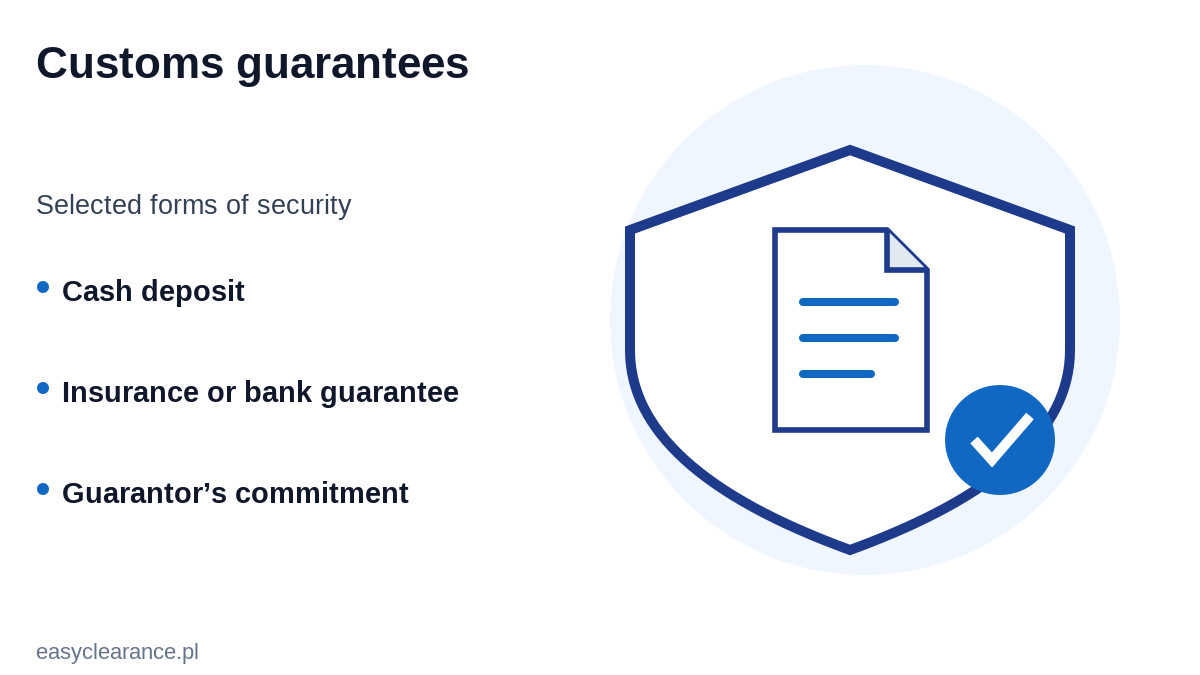
Types of guarantees:
1. Cash deposit (funds blocked on the office account). 2. Insurance/bank guarantee (Policy). 3. Guarantor's commitment (for transit procedure).In Great Britain, HMRC usually asks for a guarantee as a condition of approving a duty deferment account, and some businesses can get a waiver. Import VAT can instead be accounted for with postponed VAT accounting, without a deferment account. A CCG (Customs Comprehensive Guarantee) is required to use a duty deferment account in Northern Ireland.
What the current official guidance means in practice
For operational work, the current procedural rules, declaration fields and relief conditions should be checked directly against the official guidance. For this topic, the core reference points are European Commission, GOV.UK / HMRC.
Operational watch-outs
Most delays come from inconsistent data between the commercial invoice, packing list, tariff classification, reference numbers and transport assumptions. Before shipment release, confirm who is responsible for clearance, whether the data set is complete and when the declaration must be filed.
Documents and data to prepare
The minimum working pack worth preparing before speaking to customs support or filing a declaration includes:
- commercial invoice with a complete goods description
- packing list with quantities, weight and package count
- HS/CN code and origin information
- EORI number and the party responsible for the declaration
Practical notes for UK-PL operators
For regular flows, keep a stable data template: goods description, HS code, origin, Incoterms, carrier details and source documents. This shortens response time and reduces border corrections.
Official sources
- EU Commission (Customs procedures) — European Commission, 2026-03-04
- UK GOV (Importing into the UK) — GOV.UK / HMRC, 2026-03-04
- GOV.UK: Customs Declaration Service — GOV.UK / HMRC, 2026-03-04
Disclaimer: The information on the site is operational and informational in nature and does not constitute legal or tax advice.
Do you need support with this procedure?
Contact our operations team.