GVMS at the UK border – who is responsible for what: carrier, haulier, declarant and customs agent
Who is responsible for the GMR in the GVMS system? We explain the roles of the carrier, haulier, declarant and customs agent at the UK border. A practical responsibility matrix.
Author
easyclearance.pl teamPublished
2026-04-20
Updated
2026-06-11
The GVMS (Goods Vehicle Movement Service) transformed the way goods cross the UK border — and continues to raise questions about who is actually responsible for what. If you run a transport company, or you are an importer or exporter handling RoRo port traffic, this article will precisely explain the role of each party: carrier, haulier, declarant and customs agent.
What is GVMS and where does the GMR come from?
GVMS (Goods Vehicle Movement Service) is an HMRC digital platform that consolidates in one place all customs and transit declarations linked to a specific vehicle crossing the UK border through so-called GVMS ports (ports operating on a RoRo model, including Dover, Eurotunnel/Folkestone, and Holyhead).
Every vehicle entering or leaving the UK through a GVMS port must have a GMR (Goods Movement Reference) — a unique reference number generated within the GVMS system. The GMR acts as a digital manifest for the vehicle: it contains all the MRNs (Movement Reference Numbers) of the customs and transit declarations relating to the cargo on the trailer.
The key distinction: - GVMS = the IT system (the platform) - GMR = the document/reference number generated within that system for a specific crossing
Without a valid GMR the vehicle will not be permitted to board — the port operator (e.g. P&O Ferries, DFDS, Eurotunnel) will refuse to load it onto the ferry or into the tunnel.
Who creates the GMR — and who is responsible for it?
This is where the most common industry misunderstanding arises: the GMR is not created by the importer or the exporter. The obligation to create and manage the GMR rests with the carrier.
The carrier is the entity responsible for the physical transport of the goods — a ferry company, the Eurotunnel operator, or another transport company carrying out the crossing. It is the carrier who registers with the GVMS system and who is the only party able to create the GMR for a specific crossing.
In practice, the carrier creates the GMR and provides it to the driver (haulier), who presents it at port check-in.
Roles within the GVMS system — a detailed breakdown
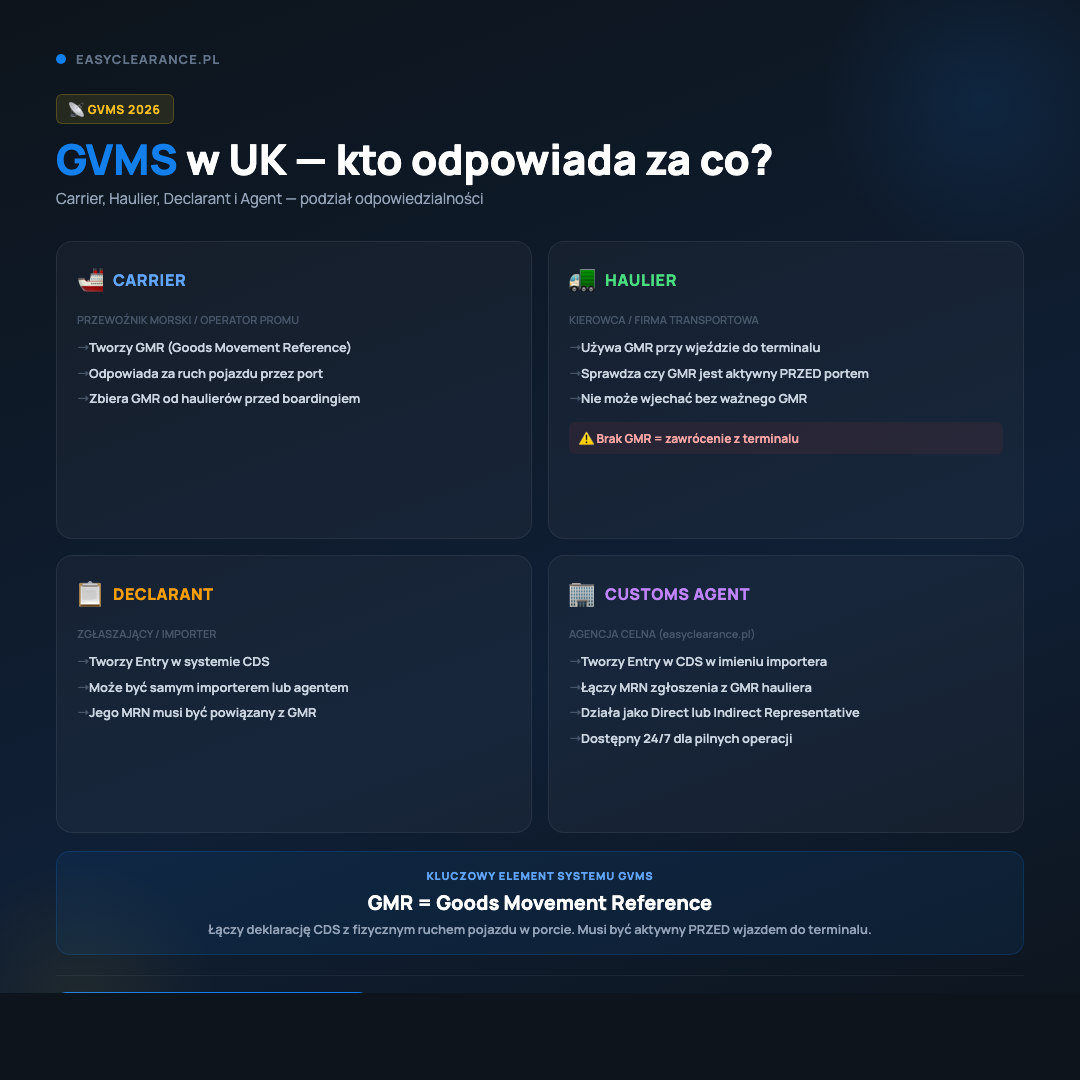
Carrier (ferry operator / tunnel operator)
The carrier is the entity that physically moves the vehicle across the border — a ferry company (P&O, DFDS, Stena Line) or the Eurotunnel operator. The carrier is responsible for creating the GMR and for ensuring that all required customs declarations have been attached to it before boarding.
Carrier responsibilities: - Registration with the GVMS system (via Government Gateway) - Creating a GMR for each vehicle crossing of the border - Providing the GMR to the driver before boarding - Verifying that the GMR is valid and complete at the time of arrival at the port
Haulier (road transport company / driver)
The haulier is the road transport company or driver carrying out the physical movement of the cargo on the trailer. The haulier does not create the GMR, but is responsible for: - Holding a valid GMR at the time of arrival at the port - Providing the tractor unit and trailer registration numbers (these must exactly match the data in the GMR) - Ensuring the vehicle data in the GMR is correct before entering the port
If the registration numbers of the tractor unit or trailer do not match the GMR, the GVMS system will reject the crossing.
Declarant
The declarant is the party submitting the customs declaration — this may be the importer, the exporter, or a customs agent acting on their behalf. The declarant is responsible for: - Submitting the import or export declaration in CDS (Customs Declaration Service) - Obtaining the MRN (Movement Reference Number) for the declaration - Passing the MRN to the carrier or haulier so they can attach it to the GMR
This is the critical link in the chain: without the MRN the carrier cannot complete the GMR, and the vehicle cannot cross the border.
Customs agent (customs brokerage)
The customs agent acts on behalf of the importer or exporter. Their role in the context of GVMS includes: - Submitting the customs declaration and obtaining the MRN - Passing the MRN to the client or directly to the carrier/haulier - Supporting the client in the event of clearance issues at the border - Under direct representation: acting on behalf of the importer/exporter (the importer remains the customs debtor)
The customs agent does not create the GMR — but without their work (the submitted declaration with its MRN) the GMR cannot be completed.
Responsibility matrix — who does what in the GVMS system
| Role | Creates GMR | Provides MRN | Responsible for vehicle data | Responsible for declaration |
|---|---|---|---|---|
| Carrier | YES | NO | YES (verification) | NO |
| Haulier | NO | NO | YES (provides reg. no.) | NO |
| Declarant / Customs agent | NO | YES | NO | YES |
| Importer / Exporter | NO | NO (if using an agent) | NO | YES (if filing directly) |
GVMS ports vs. non-GVMS ports — when is a GMR required?
A GMR is required only when crossing the border through GVMS ports (RoRo). The main GVMS ports include: - Dover - Folkestone (Eurotunnel) - Holyhead - Fishguard - Pembroke - Liverpool (certain routes)
For non-GVMS ports (e.g. airports, container terminals not operating in RoRo mode) different procedures apply — declarations are linked to the goods rather than the vehicle, and GVMS is not required.
[LINK: see the full list of GVMS ports on easyclearance.pl]
What happens if the GMR is missing or incorrect?
The consequences of not having a valid GMR are immediate and serious: - Boarding refused — the port operator will not allow the vehicle onto the ferry or into the Eurotunnel - The crossing must be rebooked — additional costs and delays - Risk of exceeding the declaration time window — a pre-lodged declaration has a limited validity period - Driver standing time and parking costs at ports (particularly acute at Dover)
If the GVMS system does not accept the GMR, you must contact the carrier immediately to verify and correct the data — not the customs agent, as the GMR is the carrier's responsibility.
FAQ
Does the importer need to register with the GVMS system? No. Neither the importer nor the exporter registers with GVMS. Registration is carried out by the carrier (the company transporting goods across the border). The importer only needs to ensure that a customs declaration is submitted (either directly or through a customs agent) and that the MRN is passed to the carrier or haulier.
Can a customs agent create the GMR on behalf of their client? No — the GMR is created exclusively by the carrier registered in the GVMS system. The customs agent is responsible for submitting the declaration and delivering the MRN, which is then attached to the GMR by the carrier.
What is an MRN and why is it needed for the GMR? An MRN (Movement Reference Number) is the unique number assigned to each customs or transit declaration once it has been submitted in CDS/NCTS. The carrier must attach the MRN for every declaration relating to the cargo to the GMR — without this the GMR is incomplete and the vehicle will not be permitted to board.
What happens if the trailer registration number changes before boarding? The carrier must update the GMR before the vehicle enters the port. A mismatch between the vehicle or trailer registration numbers and the data in the GMR will cause the crossing to be rejected by the GVMS system.
Is a GMR required for exports from the UK? Yes. A GMR is required for both imports into the UK and exports from the UK through GVMS ports. For exports, the MRN of the export declaration (EAD — Export Accompanying Document) is attached to the GMR.
How long is a GMR valid? A GMR is valid for a set period from the time it is created — typically until the crossing has been completed or the associated declarations have expired. The specific validity conditions are set by HMRC and may vary depending on the route and the operator.
Disclaimer: The information on this site is of an operational and informational nature and does not constitute legal or tax advice. The price ranges shown are indicative — an exact quote is provided once documents have been submitted.
Have a similar case?
Send us three pieces of information: the goods, the route, and the Incoterm — we will come back to you with the right clearance approach. We respond 24/7.