Express operator vs customs broker – when DHL and UPS are not enough
DHL, UPS, FedEx or a dedicated customs broker? Compare your options and find out when an express operator is not sufficient for a safe UK customs clearance.
Author
easyclearance.pl teamPublished
2026-04-20
Updated
2026-06-11
You are shipping goods between Poland and the United Kingdom and wondering whether DHL, UPS or FedEx is enough to handle customs clearance. For standard parcels — often, yes. But there is a significant grey area where express operators lose shipments at the border and their simplified processes generate errors that cost businesses thousands of pounds. Find out where the line is drawn and when it is worth calling on a dedicated customs broker.
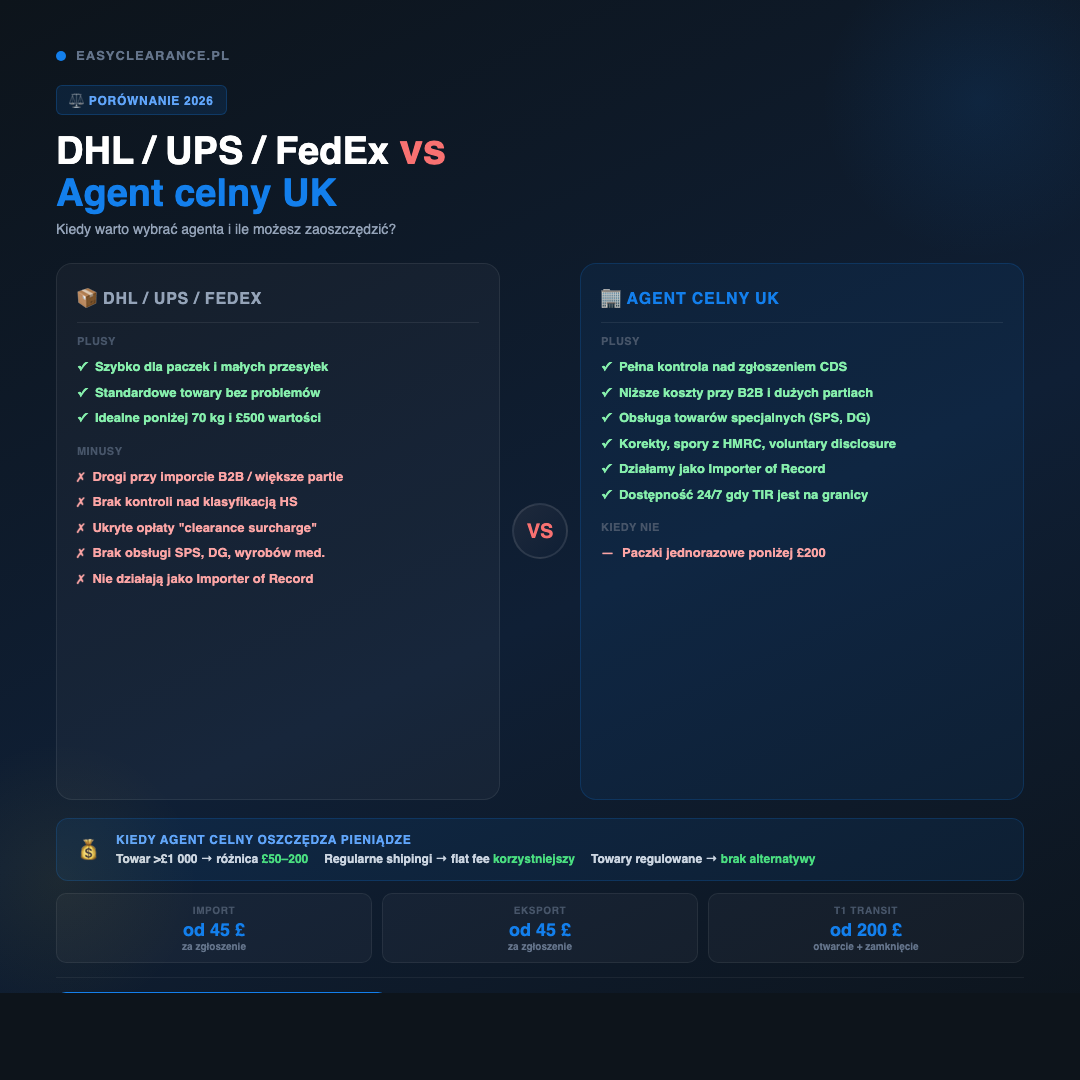
How do express operators handle customs clearance?
DHL Express, UPS, FedEx and TNT are so-called integrators — companies combining transport with simplified customs handling in a single package. Their business model is built on mass standardisation: thousands of shipments processed daily in semi-automatic mode with minimal interaction with HMRC.
Express operators typically use simplified customs procedures (Simplified Customs Procedures / Simplified Frontier Declarations), which allow fast release of goods provided that: - the goods fall within standard HS categories, - the value does not exceed risk thresholds, - the documentation is complete and consistent.
In many cases this is sufficient. Problems arise when any of these conditions is not met — and the express operator has neither the time nor the resources to verify this before clearance.
When is an express operator perfectly adequate?
There is no point engaging a dedicated customs broker for every shipment. An express operator is the right solution when:
- Goods value below £135 — for UK imports to end consumers (B2C) the low-value consignment relief for VAT applies and clearance is simplified.
- Standard goods with no restrictions — clothing, consumer electronics, furniture, office supplies that require no special licences or certificates.
- B2C e-commerce — sales to individual consumers with a one-off invoice and straightforward documentation.
- Regular shipments with an established classification — if you are sending the same product every week, the express operator "knows" your goods and the risk of error is minimal.
- Low sensitivity to clearance timing — you do not need the goods in your warehouse at a specific time.
For this type of shipment DHL and UPS do a good job and the price is lower than engaging a broker.
When is a customs broker better — or simply essential?
This is the right question — and here lies the real value for B2B importers and exporters. A customs broker becomes indispensable in the following situations:
Regulated goods requiring licences
Animal products, plants, chemicals, pharmaceuticals, alcoholic beverages, weapons, dual-use goods — all require additional documents (Health Certificates, SPS checks, export licences). Express operators often refuse to handle such goods or clear them incorrectly, resulting in detention at the border.
T1 transit
The T1 procedure is a customs transit through the UK or the EU — the goods travel "under seal" and are not cleared locally. Express operators do not handle T1 as part of their standard offering. If your goods are travelling by lorry through the UK to another EU country, you need a customs broker.
High commercial values and the risk of undervaluation
When importing expensive machinery, industrial electronics or strategic raw materials, any error in classification or customs value can result in an HMRC investigation, a financial penalty or seizure of goods. A customs broker selects the correct HS code, checks origin rules, verifies the customs value and represents the client if problems arise.
RoRo transport and groupage (LCL containers)
Cargo shipments on ferries (RoRo) or in groupage containers are outside the scope of express operator services. These require a full import or export declaration (Full Customs Entry), which is prepared by a customs broker.
Errors in previous clearances
If HMRC has opened an investigation, goods have been detained or an additional duty assessment has been issued, professional representation is required. An express operator will not negotiate with HMRC on your behalf.
The need for direct or indirect representation
A customs broker can act as a direct representative (direct representation — customs liability rests with the importer) or as an indirect representative (indirect representation — the broker becomes jointly liable for the customs debt alongside the importer). Express operators act exclusively as indirect representatives, which limits their scope for intervention.
Comparison table: express operator vs customs broker
| Criterion | Express operator (DHL/UPS/FedEx/TNT) | Dedicated customs broker |
|---|---|---|
| Price for simple shipments | Lower (included in freight) | Higher (separate fee see our pricing page) |
| B2C e-commerce handling | Yes | Yes (unnecessary for small volumes) |
| T1 transit | No | Yes |
| Regulated goods (SPS, CITES, etc.) | Limited / refuses | Yes |
| Representation in HMRC audits | None | Yes |
| HS classification verification | Simplified, automated | Manual, expert-level |
| Voluntary disclosure / settlement with HMRC | No | Yes |
| Groupage / RoRo cargo | No | Yes |
| Polish-language support | None | Easy Clearance: yes |
| Response time for problems | Corporate helpline | Direct contact with your agent |
The most common express operator errors that cost importers money
From experience we know that express operators most frequently make the following mistakes at clearance:
- Wrong HS classification — automated systems assign an incorrect tariff code, resulting in an underpayment or overpayment of duty.
- No verification of Proof of Origin — goods may qualify for 0% duty under the TCA, but without the correct document (REX statement, EUR.1) they are cleared at the MFN rate (full duty).
- Undervaluation — understating the customs value to "simplify" the procedure is a customs offence, and HMRC is increasingly effective at detecting such cases.
- No GMR for RoRo — a Goods Movement Reference is required for lorry transport through the Channel. Express operators do not handle this process for cargo.
Easy Clearance: the specialist for complex cases
Easy Clearance specialises precisely in the situations where express operators fall short. We handle B2B imports and exports between the UK and Poland — machinery, raw materials, regulated goods, T1 transit, groupage. We prepare customs declarations, represent clients before HMRC and ensure documents are ready before the driver reaches the border.
The price ranges quoted are indicative — an exact quote follows once documents are submitted.
FAQ
Can DHL handle the customs clearance for my UK import? Yes, for standard B2C shipments and low values — DHL is sufficient. Problems arise with high values, regulated goods, T1 transit or when representation before HMRC is required.
How much does a customs broker cost compared with DHL? DHL/UPS includes simplified customs handling in the freight price, but errors can end up costing you many times more in penalties and additional duties. A customs broker charges see our pricing page for full import handling, and see our pricing page for T1 transit. This is an investment in compliance, not an administrative overhead.
What does "direct representation" mean and why does it matter? Direct representation means the customs broker acts on your behalf and at your risk — you are the party before HMRC. Indirect representation means the broker assumes part of the customs liability. Express operators always act as indirect representatives, which limits their ability to negotiate with HMRC.
My goods were held at the border by DHL — what should I do? Contact us immediately. We can take over the documentation, communicate with HMRC, file a correction or submit a request for release of goods. The sooner you act, the lower the penalties.
Can a customs broker help if I previously cleared goods myself and made a mistake? Yes. The voluntary disclosure procedure allows you to self-report the error to HMRC, which significantly reduces penalties. A customs broker prepares such disclosures and negotiates the terms of a compound settlement.
Disclaimer: The information on this site is operational and informational in nature and does not constitute legal or tax advice. The price ranges quoted are indicative — an exact quote follows once documents are submitted.
Have a similar case?
Send us three pieces of information: goods, route, Incoterm — we will come back to you with the right clearance path. We respond 24/7.