EUDR in 2026: what the EU Deforestation Regulation means for importers
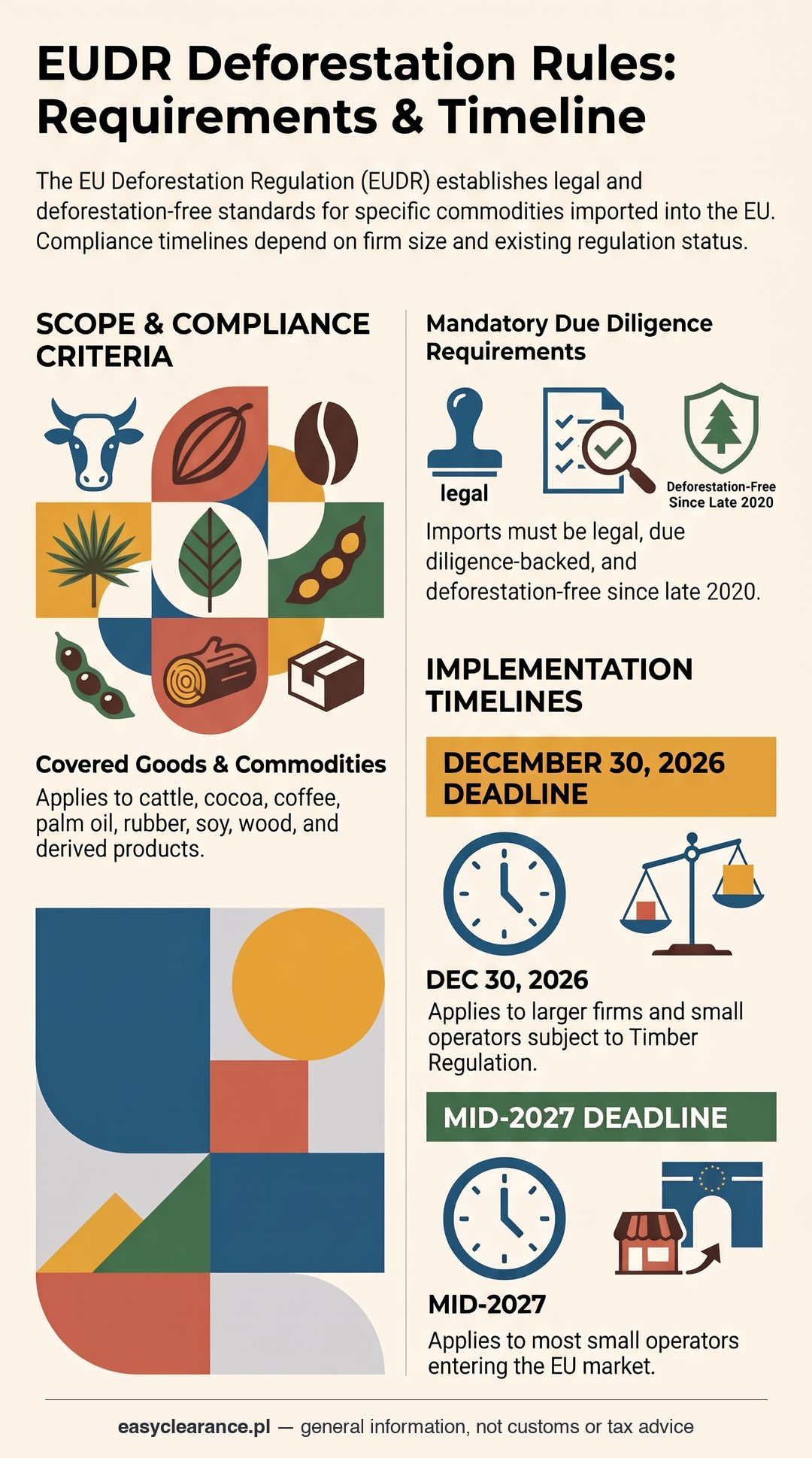
The EU Deforestation Regulation (EUDR) applies from 30 December 2026 for large and medium operators. If you import cattle products, cocoa, coffee, palm oil, rubber, soy or wood products into the EU, including from the UK, here is what applies and when.
Author
easyclearance.pl teamPublished
24 October 2026
Updated
24 October 2026
Key points
- EUDR is Regulation (EU) 2023/1115, amended in December 2024 and December 2025.
- Application: 30 December 2026 for large and medium operators; 30 June 2027 for micro and small operators established as such by 31 December 2024; 30 December 2026 also for micro and small operators as regards timber products covered by the Annex to the EU Timber Regulation (Regulation (EU) No 995/2010).
- Delegated Regulation (EU) 2026/2102 amends Annex I: some added products are covered from 30 December 2027, and some entries, such as cattle hides and leather, are removed.
- From those dates, products must be deforestation-free (no deforestation after 31 December 2020), legally produced and covered by a due diligence statement or simplified declaration.
- The UK is listed as a low-risk country, which allows simplified due diligence, but not no due diligence.
What EUDR is
Regulation (EU) 2023/1115 on deforestation-free products aims to ensure that products placed on the EU market, or exported from it, do not contribute to deforestation or forest degradation. It repeals the EU Timber Regulation (EUTR) with effect from 30 December 2026, although the EUTR continues to apply until 31 December 2029 to timber produced before 29 June 2023 and placed on the market from 30 December 2026. In December 2024 and December 2025 the EU amended EUDR, including its dates of application and simplification measures for businesses.
When it applies
According to the European Commission, the dates of application are:
- 30 December 2026: large and medium operators;
- 30 June 2027: micro and small operators established as such by 31 December 2024 (Article 38(3)), except as regards timber products covered by the Annex to the EU Timber Regulation (Regulation (EU) No 995/2010);
- 30 December 2026: micro and small operators for timber products covered by that Annex, and micro and small operators established after 31 December 2024.
Commission Delegated Regulation (EU) 2026/2102 amends Annex I. Products newly added to the scope become subject to the Regulation from 30 December 2027. The same act also removes or narrows some existing entries: for example, cattle hides and leather are removed, and tyres are narrowed to tyre treads.
Which products are covered
EUDR covers seven relevant commodities, cattle, cocoa, coffee, oil palm, rubber, soya and wood, and the relevant products listed in Annex I that contain, have been fed with or have been made using them. Examples of derived products include chocolate and wooden furniture. Always check your commodity code against the current Annex I.
The three conditions in Article 3
From the application dates, relevant commodities and products may be placed or made available on the EU market, or exported, only if they are:
- deforestation-free: produced on land not subject to deforestation after 31 December 2020, and for wood, harvested without inducing forest degradation after that date;
- produced in accordance with the relevant legislation of the country of production; and
- covered by a due diligence statement or, where applicable, a simplified declaration.
Need operational support?
Send a quick brief and get a clear next-step plan.
Who does what: operators, downstream operators and traders
An operator places relevant products on the EU market for the first time, or exports them. When goods come from outside the EU, including the UK, that is typically the EU importer. From the application date, operators will have to exercise due diligence before placing products on the market and submit a due diligence statement through the EUDR information system; by doing so they take responsibility for compliance. They must keep records of their statements for five years. Micro and small primary operators can instead submit a one-time simplified declaration.
Downstream operators and traders further down the chain have lighter obligations. They will have to collect and keep, for at least five years, the details of their suppliers and customers and, where their supplier is an operator, the reference numbers of the due diligence statements. Downstream operators and traders that are not SMEs must also register in the information system.
EUDR at the border: what customs will ask for
From the application date, EUDR controls apply to relevant products released for free circulation or exported. Under Article 26(4), the reference number of the due diligence statement, or the declaration identifier for micro and small primary operators, must be made available to customs before release for free circulation or export. The person lodging the customs declaration provides it, unless it is available through the electronic interface between customs and the information system. Where the competent authority has flagged a product for checks, customs suspend its release.
For an import into Poland, this means the reference number needs to reach whoever prepares the import declaration before the goods arrive. Our guide to customs duty and VAT on imports from the UK to Poland covers the rest of the clearance.
Importing from the UK: low risk, but not exempt
Commission Implementing Regulation (EU) 2025/1093 classifies countries by risk. The United Kingdom appears on its list of low-risk countries (check the current version of the list before you rely on it). Under Article 13 EUDR, an operator sourcing only from low-risk countries can use simplified due diligence: it does not have to carry out the full risk assessment and risk mitigation steps, provided it has checked the complexity of the supply chain and the risk of circumvention or of mixing with products from standard or high-risk countries. It still needs a due diligence statement, and must do full due diligence if it learns of a risk.
Low risk refers to the country of production. Wood products made in the UK from timber grown elsewhere are assessed against the country where that timber was produced. Our guides to ISPM 15 wooden pallets and exporting wood products to the UK cover related rules for wood.
Checklist for importers
- Check whether your commodity codes are in Annex I, including the products added from 30 December 2027.
- Work out whether you are an operator, a downstream operator or a trader, and whether you are an SME.
- Collect geolocation and legality information from your suppliers, and confirm the country of production.
- Submit the due diligence statement (or simplified declaration) before placing goods on the market.
- Pass the reference number to whoever lodges your import declaration.
Easy Clearance is a customs agency registered in CDS with a UK EORI, handling import clearance into Poland and UK–EU shipments. To prepare your first EUDR-compliant import, contact us.
Official sources
- European Commission: Regulation on deforestation-free products (EUDR) — European Commission, checked 2026-10-24
- EUR-Lex: Regulation (EU) 2023/1115 (EUDR), consolidated text — European Union, checked 2026-10-24
- EUR-Lex: Implementing Regulation (EU) 2025/1093 (country benchmarking) — European Union, checked 2026-10-24
- European Commission: EUDR implementation (Green Business) — European Commission, checked 2026-10-24
FAQ
When does EUDR apply?
From 30 December 2026 for large and medium operators, from 30 June 2027 for micro and small operators established as such by 31 December 2024, except for timber products covered by the Annex to the EU Timber Regulation (Regulation (EU) No 995/2010), for which 30 December 2026 applies to them too. Products added by Delegated Regulation (EU) 2026/2102 are covered from 30 December 2027.
Which products does EUDR cover?
Cattle, cocoa, coffee, oil palm, rubber, soya and wood, and the relevant products listed in Annex I that contain, have been fed with or have been made using them. Annex I was amended by Delegated Regulation (EU) 2026/2102, so check the current list.
What does deforestation-free mean?
Under Article 2 EUDR, the commodities were produced on land not subject to deforestation after 31 December 2020, and for wood, harvested without inducing forest degradation after that date.
Is the UK a low-risk country under EUDR?
Yes. Implementing Regulation (EU) 2025/1093 lists the United Kingdom as low risk. Operators sourcing from low-risk countries can use simplified due diligence under Article 13, but still need a due diligence statement.
What does customs need for an EUDR product?
From the application date, under Article 26(4), the reference number of the due diligence statement, or the declaration identifier for micro and small primary operators, must be made available to customs before release for free circulation or export.
Does an FSC or PEFC certificate replace due diligence?
No. Recital 52 of the Regulation says certification or other third-party verified schemes can be used in the risk assessment, but should not substitute the operator's responsibility for due diligence.
Disclaimer: This article is general information on the rules as they stand in October 2026. It does not constitute legal, tax or customs advice. Check the official sources for your specific goods and situation.
Importing wood, coffee or cocoa into the EU?
We handle import clearance into Poland and help importers make sure the right references are ready before the goods arrive.