Exporting furniture to the UK – customs, certificates and UKCA requirements [Guide 2026]
After Brexit, exporting furniture to the UK requires full customs clearance, tariff classification and – in some cases – compliance with UKCA (UK Conformity Assessed) requirements. Poland is one of the largest furniture exporters in Europe, and the United Kingdom remains a key market for Polish manufacturers.
Status
verified against official sources
Author
easyclearance.pl teamPublished
18 February 2026
Updated
4 March 2026
Quick definition
After Brexit, exporting furniture to the UK requires full customs clearance, tariff classification and – in some cases – compliance with UKCA (UK Conformity Assessed) or CE marking requirements. Poland is one of the largest furniture exporters in Europe, and the United Kingdom remains a key market for Polish manufacturers. This article explains the customs rates for furniture, when UKCA or CE marking is needed, how to correctly classify furniture, and which documents are necessary for export.
Poland is one of the largest furniture exporters in Europe, and the United Kingdom remains a key market for Polish manufacturers. After Brexit, exporting furniture to the UK requires full customs clearance, tariff classification and – in some cases – compliance with UKCA (UK Conformity Assessed) or CE marking requirements.
Need operational support?
Send a quick brief and get a clear next-step plan.
This article explains the customs rates for furniture, when UKCA or CE marking is needed, how to correctly classify furniture, and which documents are necessary for export.
Customs classification of furniture (CN codes)
Furniture is classified in Chapter 94 Combined Nomenclature (CN). Duty rate depends on the type of furniture, material and purpose.
Most common CN codes for furniture:
| CN Code | Description | Duty Rate (standard) | |---|---|---| | 9403.10 | Metal office furniture | 0% | | 9403.20 | Other metal furniture | 0% | | 9403.30 | Wooden office furniture | 0% | | 9403.40 | Wooden kitchen furniture | 2% | | 9403.50 | Wooden bedroom furniture | 0% | | 9403.60 | Other wooden furniture | 0% | | 9403.70 | Plastic furniture | 0% | | 9403.82 / 9403.83 / 9403.89 | Furniture of bamboo / of rattan / of other materials | 4% | | 9401.31 / 9401.39 | Height-adjustable swivel seats (wooden / other) | 0% | | 9401.61 | Upholstered chairs with wooden frame | 0% | | 9401.71 | Upholstered metal chairs | 0% |
Important: The rates in the table are standard UK Global Tariff (UKGT) rates according to the UK Trade Tariff. For most Chapter 94 furniture the standard rate is 0% even without preference. For items with a rate above 0% (e.g. 9403.40 – 2%, 9403.82/9403.83/9403.89 – 4%), 0% duty can be obtained under the TCA (EU-UK Trade and Cooperation Agreement), provided the rules of origin are met and a statement on origin is made.How to check the exact customs duty rate?
1. Go to the website gov.uk/trade-tariff. 2. Enter the CN code (e.g. 9403.60). 3. Check the customs duty rate and additional requirements (certificates, licences).
Furniture duty – how to calculate?
Example 1: Wooden furniture (CN code 9403.60)
Data: - Customs value: £10,000 - Customs duty rate: 0% (TCA) - VAT: 20% Calculations: - Duty: £10,000 × 0% = £0 - VAT base: £10,000 + £0 = £10,000 - VAT: £10,000 × 20% = £2,000 - Total cost: £2,000 (VAT only)Example 2: Plastic furniture (CN code 9403.70)
Data: - Customs value: £10,000 - Customs duty rate: 0% (standard UKGT rate) - VAT: 20% Calculations: - Customs duty: £10,000 × 0% = £0 - VAT base: £10,000 + £0 = £10,000 - VAT: £10,000 × 20% = £2,000 - Total cost: £2,000 (VAT only) Conclusion: Duty above 0% applies only to some items (e.g. wooden kitchen furniture 9403.40 – 2%; furniture of bamboo, rattan or other materials 9403.82–9403.89 – 4%); for those, a statement on origin (TCA) allows 0% to be applied.UKCA requirements for furniture
When does furniture require UKCA or CE marking?
UKCA (UK Conformity Assessed) is a marking, not a certificate. It concerns furniture that contains electrical components (e.g. desks with built-in sockets, beds with LED lighting) – in Great Britain the UKCA or the CE marking can be used. Children's furniture (e.g. cots, high chairs) is subject to general product safety rules and standards (e.g. BS EN 716), not automatically to UKCA marking.
Wooden/metal furniture without electrical components
Most traditional furniture (tables, chairs, wardrobes, chests of drawers) does not require UKCA or CE marking. It is sufficient to: - commercial invoice. - Customs declaration. - Statement of origin (if using TCA).
Furniture with electrical components
If the furniture contains electrical components (e.g. desk with built-in sockets), it must comply with: - UK Electrical Equipment (Safety) Regulations 2016. - UKCA or CE marking on the product or packaging. - UK Declaration of Conformity (UK Declaration of Conformity).
How to prepare the marking? 1. Assess the product's compliance with the requirements of the regulations. 2. Prepare technical documentation and a declaration of conformity. 3. Affix the UKCA or CE marking on the product.Children's furniture
Furniture intended for children (cribs, high chairs) must comply with: - UK Furniture and Furnishings (Fire Safety) Regulations 1988. - BS EN 716 (safety standard for baby cots). - UKCA marking (if applicable).
Requirements for wooden pallets (ISPM 15)
If furniture is transported on wooden pallets, the pallets must be marked according to ISPM 15 standard (International Standards for Phytosanitary Measures).
Requirements: - Pallets must be thermally treated (HT – Heat Treatment). - Pallets must have IPPC marking (International Plant Protection Convention). Why is it important? Lack of ISPM 15 marking may result in: - Shipment being held at the border. - Need to replace pallets. - Delivery delays. More information: Wooden pallets ISPM 15 – requirements for export to the UKDocuments required for furniture export
1. Commercial Invoice
Required elements: - Exporter data (name, address, EORI PL). - Importer data (name, address, EORI GB). - Detailed furniture description (e.g. "Oak wooden table, dimensions 180x90x75 cm"). - CN code (e.g. 9403.60.10). - Quantity, unit price, total value. - Delivery terms (Incoterms 2020). - Statement of origin (if using TCA). More information: Commercial invoice to the UK – 7 elements required by HMRC2. Packing List
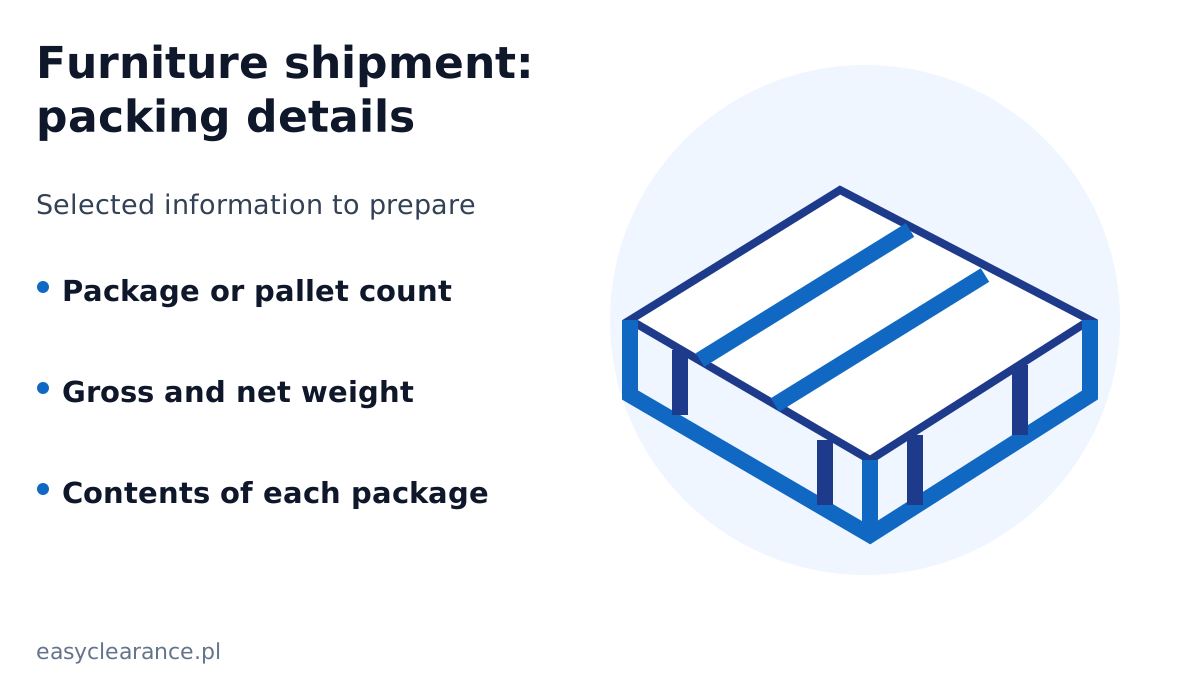
Required elements: - Number of packages/pallets. - Gross and net weight. - Package dimensions. - Description of each package's contents.3. CMR Document (International Consignment Note)
Required elements: - Sender and recipient data. - Description of goods. - Number of packages, weight. - Carrier’s signature.4. Statement of origin (if TCA applies)
If the importer wants to apply the preferential 0% rate under the TCA (relevant for items whose standard UKGT rate is above 0%), the invoice must include a statement of origin:
``` "The exporter of the products covered by this document declares that, except where explicitly stated otherwise, these products have preferential EU origin." ```
5. UKCA or CE marking (if applicable)
If the furniture contains electrical components, prepare: - UK Declaration of Conformity. - Technical documentation supporting the UKCA or CE marking.
Most common errors in furniture export
Error 1: Incorrect customs classification
❌ "Furniture" – too general. ✅ "Oak wooden table, dimensions 180x90x75 cm, for domestic use" + CN code 9403.60.10.
Error 2: Missing statement of origin
❌ Invoice without a statement of origin for an item with a standard UKGT rate above 0% (e.g. 9403.40, 9403.89) → standard duty (2–4%). ✅ Invoice with a statement of origin → 0% duty (TCA). For furniture whose standard UKGT rate is 0%, a missing statement does not change the duty.
Error 3: Pallets without ISPM 15 marking
❌ Wooden pallets without marking → held at the border. ✅ Pallets with IPPC (HT) marking → no issues.
Error 4: Missing UKCA or CE marking for electrical furniture
❌ Desk with built-in sockets without UKCA or CE marking → risk of being held for inspection. ✅ Desk with UKCA or CE marking and declaration of conformity → lower risk of problems.
How can easyclearance.pl assist?
Customs classification verification
Our team can assist with: - Correct classification of furniture (CN code). - Checking the customs duty rate in the UKGT tariff. - Determining if the furniture qualifies for TCA (0% duty).
Preparation of documentation
We can help prepare: - Commercial invoice compliant with HMRC requirements. - Statement of origin (TCA). - Packing list and CMR documents.
Customs clearance in the UK
If your UK client lacks customs clearance experience, we can: - Perform import clearance in the UK on our behalf EORI number GB. - Account for VAT via Postponed VAT Accounting (PVA). - Coordinate delivery to the client.
Distinction: easyclearance.pl is a customs agency based in the UK. We directly handle clearances in Great Britain. If your shipment requires customs clearance in Poland or another EU country, we coordinate the process through our network of local partners with the required customs authorisations.Frequently Asked Questions (FAQ)
Do wooden furniture require a phytosanitary certificate?
No, if the wood has been processed (finished furniture). Phytosanitary certificate is required only for raw wood (e.g. logs, planks).
Can I export used furniture to the UK?
Yes, but you must document that the furniture is used (e.g. photos, statement). Used furniture may qualify for a lower customs value.
Do upholstered furniture require additional certificates?
If furniture is intended for the UK market, it must comply with UK Furniture and Furnishings (Fire Safety) Regulations 1988 (fire resistance standards). The manufacturer must have a fire resistance certificate for fabrics.
How long does customs clearance of furniture in the UK take?
Standard 1-3 working days. If the shipment is directed for inspection (Route 2), it may take 5-10 days.
Can I export furniture under DDP terms?
Yes, but this requires VAT registration in the UK or using a local importer. We recommend FCA or DAP for most exporters.
More information: Incoterms 2020 in trade with the UK – why DDP is a trap?Summary
Exporting furniture to the UK is relatively straightforward if you follow basic rules:
1. Customs classification – Use the correct CN code (Chapter 94). 2. 0% Duty – The standard UKGT rate for most furniture is 0%; for items with a 2–4% rate, TCA preference gives 0%. 3. UKCA or CE – Applies to furniture with electrical components; children's furniture is subject to general product safety rules and standards. 4. ISPM 15 pallets – Ensure pallets are labelled. 5. Documentation – Commercial invoice, packing list, CMR, statement of origin.
Do you need help with exporting furniture to the UK?
If you export furniture to the United Kingdom and need support with customs classification, documentation preparation or customs clearance, contact easyclearance.pl.
easyclearance.pl is a customs agency based in the United Kingdom. We directly handle clearances in the UK. Customs clearances within the EU are carried out in cooperation with our network of local partners with the required customs authorisations. Contact us →What the current official guidance means in practice
For operational work, the current procedural rules, declaration fields and relief conditions should be checked directly against the official guidance. For this topic, the core reference points are European Commission, GOV.UK / HMRC.
Official sources
- EU Commission (Customs procedures) — European Commission, 2026-03-04
- UK GOV (Importing into the UK) — GOV.UK / HMRC, 2026-03-04
- GOV.UK: Customs Declaration Service — GOV.UK / HMRC, 2026-03-04
Disclaimer: The information on the site is operational and informational in nature and does not constitute legal or tax advice.
Do you need support with this procedure?
Contact our operations team. We respond 24/7.