UK CBAM for Fertilisers — What Polish Exporters Need to Know
UK CBAM was enacted through the Finance Act 2026 and comes into force on 1 January 2027. Fertilisers are among the covered sectors. This article covers the implications specifically for Polish fertiliser manufacturers and traders exporting to the United Kingdom. From 1 January 2027, UK importers of Polish nitrogen fertilisers, ammonia, urea and compound fertilisers (headings 3102 and 3105, excluding 3105 60; ammonia 2814) pay UK CBAM — a tax paid to HMRC through CBAM returns, with no certificates to buy or surrender. Preparation should begin now. The EU CBAM (Regulation (EU) 2023/956) — covering imports into the EU — is already enacted and separately covers fertilisers. This article discusses UK CBAM only. This article reflects the legal position as of 2026-10-05 — contact a customs broker before taking any action.
Autor
Easy Clearance EditorialPublikacja
2026-04-18
Zaktualizowano
2026-10-05
Fertilisers in the Proposed UK CBAM — Scope and HS Codes
Understanding which products are in scope is the essential first step for Polish fertiliser exporters.
Which fertiliser products are proposed to be covered
According to HMRC's list Goods within the fertiliser sector, UK CBAM covers:
- 2808 00 — Nitric acid; sulphonitric acids
- 2814 — Ammonia, anhydrous or in aqueous solution
- 2834 21 — Nitrates of potassium
- 3102 — Mineral or chemical fertilisers, nitrogenous (ammonium nitrate, urea, calcium nitrate)
- 3105 — Mineral or chemical fertilisers containing two or three fertilising elements, and other fertilisers — excluding 3105 60 (phosphorus and potassium only)
Purely phosphatic (3103) and purely potassic (3104) fertilisers are not on the list. Source: Finance Act 2026; GOV.UK — goods within the fertiliser sector. This article reflects the legal position as of 2026-10-05 — contact a customs broker before taking any action.
Why fertilisers are carbon-intensive — the policy rationale
Nitrogen fertilisers are among the most carbon-intensive industrial products. The Haber-Bosch process for producing ammonia (the building block of most nitrogen fertilisers) requires hydrogen — currently derived primarily from natural gas through steam methane reforming, which generates approximately 1.6–2.0 tonnes of CO2 per tonne of ammonia. The entire fertiliser sector accounts for approximately 1–2% of global energy consumption and a corresponding share of industrial CO2 emissions. The CBAM rationale for fertilisers is therefore straightforward: to prevent 'carbon leakage' where fertiliser production migrates to countries with lower carbon costs. Polish fertiliser producers operating under the EU ETS (European Union Emissions Trading Scheme) already pay a carbon price on their emissions — this existing carbon cost would be taken into account when calculating the UK CBAM charge, preventing double-charging.
Interaction with EU CBAM (already in force) and UK CBAM (proposed)
Polish fertiliser exporters face two separate CBAM frameworks depending on the direction of trade:
Exporting to the EU (domestic Polish sales or EU sales): not subject to CBAM — EU CBAM applies to imports from third countries, and Poland is an EU Member State.
Importing from the UK to Poland: EU CBAM (Regulation (EU) 2023/956) already applies to UK-origin fertilisers entering Poland. Polish importers of UK fertilisers are already in the EU CBAM transitional phase (since October 2023) and must be aware of their existing reporting obligations.
Exporting from Poland to the UK: subject to UK CBAM (Finance Act 2026) from 1 January 2027 — the UK importer pays the tax to HMRC. This is the scenario this article addresses.
Embedded Carbon Methodology for Fertilisers
UK CBAM (Finance Act 2026) comes into force 1 January 2027. UK importers will need to declare the embedded carbon content of each shipment. Polish exporters will need to provide this data.
What 'embedded carbon' means for fertilisers
Embedded (or embodied) carbon is the total greenhouse gas emissions associated with producing a tonne of fertiliser, measured in tonnes of CO2 equivalent (tCO2e). For nitrogen fertilisers, this includes: (1) direct process emissions at the production facility (Scope 1) — primarily from the steam reforming of natural gas and from the catalytic oxidation of ammonia; (2) indirect emissions from purchased electricity used in production (Scope 2); and in some frameworks, (3) upstream emissions from natural gas extraction (Scope 3). The EU CBAM methodology (Commission Implementing Regulation (EU) 2023/1773) also covers indirect emissions from electricity for some sectors including fertilisers. UK CBAM, at the start, covers direct emissions only — indirect emissions are out of scope; UK rules on monitoring and verification are set out in the CBAM (Emissions and Verification) Regulations 2026.
Default emission values vs installation-specific data
Under the EU CBAM framework, importers can declare either: (1) installation-specific emission data, verified by an accredited verifier; or (2) default emission values published by the CBAM authority for the relevant sector and country of origin. UK CBAM also provides default emissions values, published in a notice on GOV.UK before CBAM starts; where actual emissions are lower than the default, using installation-specific data reduces the importer's CBAM tax. Polish fertiliser producers with modern, efficient plants (including those using natural gas with low carbon intensity or with process optimisation investments) should invest in installation-specific data collection and verification now, to reduce their UK buyers' CBAM tax from 1 January 2027.
Practical steps for Polish fertiliser exporters
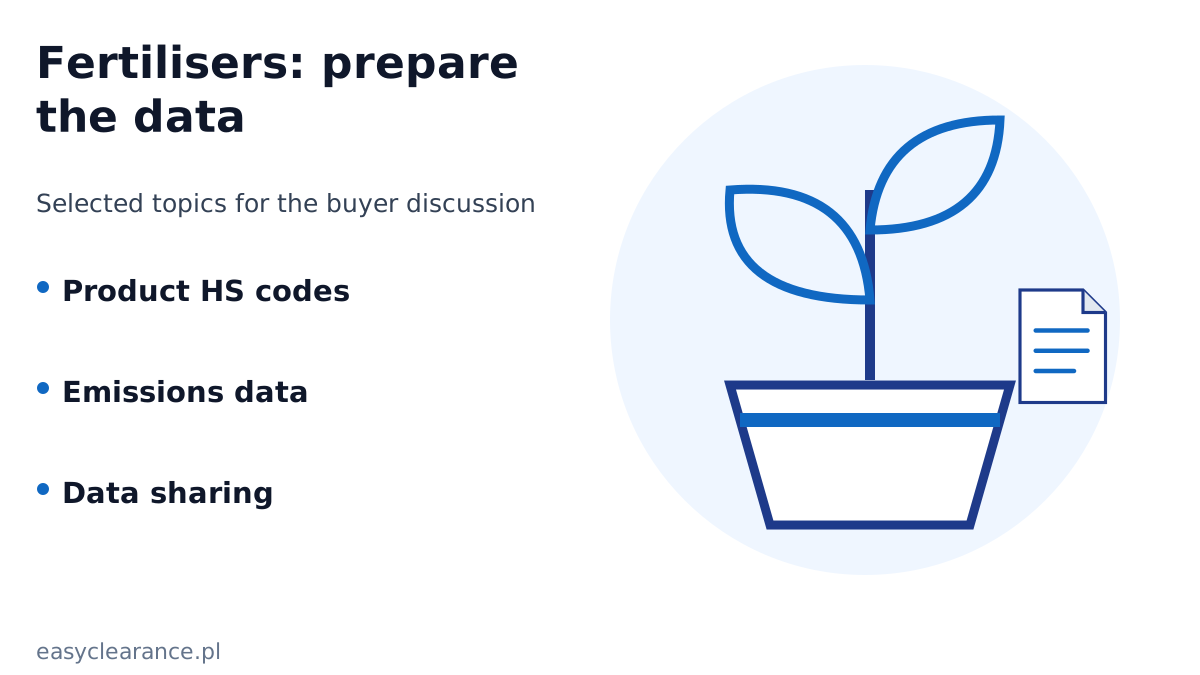
Recommended actions now that UK CBAM has been enacted (Finance Act 2026, in force 1 January 2027): (1) confirm the HS codes of your fertiliser products are within the covered scope; (2) calculate or commission a carbon footprint assessment for your main fertiliser products using the EU CBAM methodology as a reference — this data will transfer to UK CBAM with minimal adjustment; (3) engage with your UK buyers to discuss data sharing requirements and CBAM adjustment clauses in contracts; (4) monitor HMRC guidance through gov.uk/government/collections/carbon-border-adjustment-mechanism and industry bodies (e.g. The Fertiliser Manufacturers' Association or equivalent). Easy Clearance can assist with customs documentation and declarations. Contact us: WhatsApp +44 7404 091503. This article reflects the legal position as of 2026-10-05 — contact a customs broker before taking any action.
What the current rules say
UK CBAM was enacted through the Finance Act 2026 and covers fertilisers (3102 and 3105 excluding 3105 60, plus ammonia 2814, nitric acid 2808 00 and potassium nitrate 2834 21) from 1 January 2027. It is a tax paid to HMRC by the UK importer — there are no CBAM certificates. Polish fertiliser exporters to the UK should now: confirm their products' HS codes and in-scope status; calculate embedded carbon using EU CBAM methodology as a template; discuss data sharing and CBAM adjustment clauses with UK buyers; and monitor HMRC guidance. This article reflects the legal position as of 2026-10-05 — contact a customs broker before taking any action.
FAQ — frequently asked questions
Are Polish fertiliser exports to the UK subject to CBAM?Yes, from 1 January 2027. UK CBAM was enacted through the Finance Act 2026. The UK importer pays the tax to HMRC (no certificates) once its CBAM goods reach £50,000 over 12 months; the first return and payment, for 2027, are due by 31 May 2028. Polish exporters should prepare embodied emissions data for their UK buyers. Monitor gov.uk/government/collections/carbon-border-adjustment-mechanism.
Which fertilisers are included in UK CBAM?Covered codes: 3102 (nitrogenous fertilisers), 3105 (compound fertilisers, excluding 3105 60), ammonia (2814), nitric acid (2808 00) and potassium nitrate (2834 21). Purely phosphatic (3103) and potassic (3104) fertilisers are not on HMRC's list.
How is embedded carbon calculated for fertilisers?At the start, UK CBAM covers direct emissions only — indirect emissions from electricity are out of scope. For nitrogen fertilisers, the main emission source is the Haber-Bosch process for ammonia production. Where actual data is unavailable, default emissions values published on GOV.UK apply.
Does the EU ETS carbon cost paid by Polish producers count against UK CBAM?Potentially — UK CBAM provides carbon price relief: where goods were subject to a qualifying carbon pricing scheme abroad, relief can be deducted from the CBAM charge (embodied emissions × CBAM rate). Relief is claimed with supporting documentation; check HMRC guidance for which schemes and evidence qualify.
Official sources
- UK Carbon Border Adjustment Mechanism — GOV.UK
- EU CBAM — Regulation (EU) 2023/956 — EUR-Lex
- EU CBAM implementing regulation (EU) 2023/1773 — EUR-Lex
Disclaimer: This information is operational/informational and does not constitute legal or tax advice. Sprawdzono: 2026-10-05.
See also
Questions about CBAM obligations for your fertiliser exports to the UK? Contact Easy Clearance. WhatsApp: https://wa.me/447404091503?text=UK+CBAM+fertilisers&utm_source=easyclearance.co.uk&utm_medium=article&utm_campaign=cbam-uk-nawozy-eksport-z-polski Tel: +44 7404 091503
Contact us — we answer 24/7. We serve Polish exporters and freight forwarders on the PL–UK route.