Arrived vs pre-lodged declaration – how to choose the right clearance model at a UK port
Arrived or pre-lodged? We explain the difference between these UK import clearance models, when to use each one, and how to avoid congestion at Dover.
Author
Easy Clearance teamPublished
2026-04-20
Updated
2026-06-11
When goods travel from Poland to the United Kingdom, one of the first operational decisions concerns the customs clearance model: arrived or pre-lodged? The choice can have a direct impact on clearance time, the risk of goods being held, and the smooth running of your supply chain. We explain how both models work, when each performs best, and the mistakes importers most commonly make.
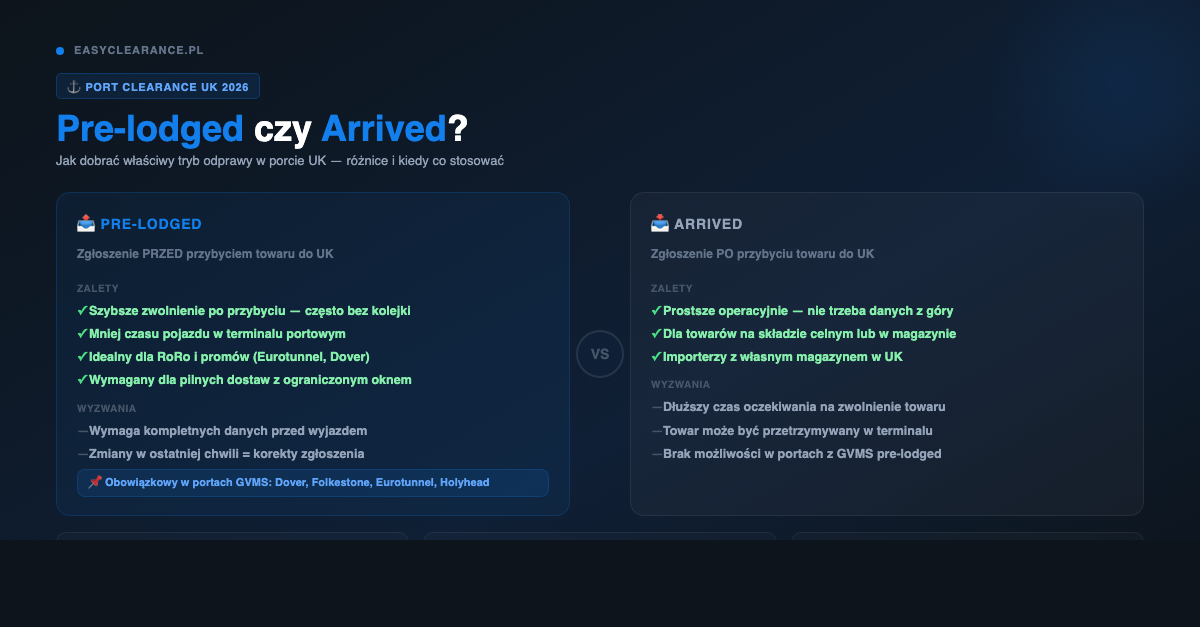
Two UK import clearance models — what sets them apart?
The fundamental difference lies in the timing of the customs declaration relative to the physical arrival of the goods in the UK.
Arrived declaration — a declaration submitted after the goods have arrived in the UK. The goods first go to an approved temporary storage facility (ETSF — External Temporary Storage Facility), where they await clearance. Only after physical arrival does the declarant submit a full import declaration in the CDS (Customs Declaration Service) system.
Pre-lodged declaration (frontier declaration) — a declaration submitted before the goods cross the UK border. The importer or customs agent sends the declaration in advance, and the CDS system assigns an MRN. By the time the goods arrive at the port, the declaration is already active — the goods can be cleared immediately on arrival or even without having to enter temporary storage.
The arrived model — when does it work and what role does the ETSF play?
The arrived model is a common choice for sea freight in containers, or when the importer does not know the exact arrival date and time. The procedure is as follows:
- Goods arrive in the UK (seaport, container terminal)
- The vehicle or container goes to an ETSF — External Temporary Storage Facility (an external temporary storage facility approved by HMRC)
- At the ETSF, goods may be held for up to 90 days (for standard imports) without incurring duty
- The declarant submits a full import declaration — the CDS system verifies the data and assigns an MRN
- Once a Release decision is issued, the goods leave the ETSF
Limitations of the arrived model: - Requires access to an ETSF or an agreement with a temporary storage operator - Additional storage costs at the ETSF (particularly with longer waiting times) - Not available at all ports or for all modes of transport
The pre-lodged (frontier) model — when is it the only option?
Pre-lodged is the mandatory model for RoRo transport through GVMS ports (Dover, Eurotunnel/Folkestone, Holyhead and others). At these ports there is no physical possibility of stopping goods and directing them to an ETSF — heavy goods vehicles are processed on the move (in flow).
With pre-lodged, the declaration must be submitted before the vehicle enters the port zone. The MRN from the declaration is then attached to the GMR (Goods Movement Reference) by carriers — without a complete GMR, boarding is not possible.
The pre-lodged procedure step by step: 1. The customs agent or declarant submits the import declaration in CDS in advance 2. The CDS system processes the declaration and assigns an MRN 3. The MRN is passed to the carrier, who attaches it to the GMR 4. The driver with a complete GMR enters the port and clears customs at the border control 5. The goods are released to free circulation (or directed to inspection)
For RoRo ports, pre-lodged is the standard, not the exception. Arriving at Dover or Eurotunnel without a submitted declaration means refusal of entry or serious delays.
Differences by port type and mode of transport
| Port type / transport | Arrived available? | Pre-lodged required? | GVMS port? |
|---|---|---|---|
| Dover (RoRo) | NO | YES | YES |
| Eurotunnel / Folkestone | NO | YES | YES |
| Holyhead (RoRo) | NO | YES | YES |
| Felixstowe (container) | YES | Optional | NO |
| Southampton (container) | YES | Optional | NO |
| Airport (Heathrow, Gatwick) | YES | Optional | NO |
| Inland clearance depot | YES | NO | NO |
What determines the choice of model — practical guidance
Choosing between arrived and pre-lodged is not just a technical matter — it has real consequences for your supply chain:
Choose pre-lodged when: - Goods are travelling by road through RoRo ports (Dover, Eurotunnel) — there is no alternative here - You need maximum clearance speed without additional storage costs - You know the goods data early enough to submit the declaration before the transport departs
Consider arrived when: - Goods are travelling by sea in a container and the arrival date may change - You need time to verify documents before submitting the final declaration - You are using a terminal with its own ETSF and have a storage agreement in place
The risk of missing pre-lodged at Dover: Dover handles hundreds of lorries every day. Congestion is a real threat here — particularly when many importers simultaneously lack ready declarations. Every vehicle without a complete GMR (and therefore without a declaration MRN) must leave the queue and wait. At peak periods, the cascade effect can mean multi-hour delays across the industry.
[LINK: how GVMS works and who is responsible for the GMR — read our article]
Inland clearance — an alternative for regular importers
Importers with high delivery volumes often opt for inland clearance — clearance inland, away from the port. In this model: - Goods cross the border under a transit procedure (T1) - The final clearance takes place at an approved location (e.g. the importer's warehouse) - The declaration is submitted as arrived when the goods are delivered to the clearance location
Inland clearance allows more time to prepare documents and avoids port congestion, but requires an active T1 transit and an approved clearance location.
[LINK: what is T1 transit and when is it required]
FAQ
Can I change the clearance model after submitting a pre-lodged declaration? To a limited extent. If the pre-lodged declaration has been submitted but the goods have not yet crossed the border, it may be possible to invalidate it and submit a new one. After crossing the border, any change is significantly more difficult and may require contact with HMRC. It is best to decide on the clearance model before submitting the declaration.
How far in advance of arriving at Dover does a pre-lodged declaration need to be submitted? HMRC does not specify a minimum lead time, but in practice the declaration should be submitted and the MRN obtained at least a few hours before boarding — the carrier needs time to create and close the GMR. We recommend submitting the declaration the day before the planned crossing.
Are ETSF and temporary storage the same thing? Yes — ETSF (External Temporary Storage Facility) is the official name for an HMRC-approved location for the temporary storage of goods awaiting customs clearance. Every ETSF must hold HMRC authorisation.
Is a pre-lodged declaration more expensive than arrived? The fee charged by the customs agency does not usually depend on the declaration model. Any cost difference arises from potential ETSF storage costs under the arrived model. At our agency, import clearance see our pricing page — an exact quote is provided once documents have been submitted.
What is frontier clearance and does it differ from pre-lodged? "Frontier clearance" is a colloquial term for clearance directly at the border under the pre-lodged model. In practice the terms are used interchangeably — both mean that the declaration is submitted before the goods arrive and clearance takes place at the moment of border crossing, with no ETSF stage.
Want certainty that the declaration is ready before your driver reaches the port?
Our team at Easy Clearance handles both pre-lodged clearances (RoRo, Eurotunnel, Dover) and arrived clearances (containers, airports). We will deliver the MRN in time for your carrier to complete the GMR without any stress.
Contact us: - WhatsApp: +44 7404 091503 - Tel: +44 7404 091503 - [LINK: send documents via the form on easyclearance.pl]
The price ranges given are indicative — an exact quote is provided once documents have been submitted.
Disclaimer: The information on this page is operational and informational in nature and does not constitute legal or tax advice. The price ranges given are indicative — an exact quote is provided once documents have been submitted.
Got a similar case?
Send us three details: goods, route, Incoterm — we will come back with the right clearance route. We respond 24/7.