TL;DR — key information
- Port of Hull: P&O Ferries runs a daily Hull–Rotterdam ferry service for freight, and Hull Container Terminal handles short-sea container services
- GVMS at Hull: HMRC lists Hull as a GVMS location for goods moving into Great Britain when the carrier is P&O
- To prepare: UK EORI number, commercial invoice and packing list, commodity codes, proof of origin
- Service fees: see our pricing page
Leeds, Yorkshire and the Humber ports
Many Yorkshire importers bring EU goods in through the Humber. At the Port of Hull, P&O's Hull–Rotterdam daily ferry service carries freight, cars and passengers, and Hull Container Terminal handles short-sea container services, including weekday Samskip sailings to Rotterdam (ABP — Port of Hull).
HMRC lists Hull as a location where the Goods Vehicle Movement Service may be used for goods moving into Great Britain if the carrier is P&O (list of GVMS ports). For those movements the haulier needs a goods movement reference (GMR) that links the customs declaration references to the vehicle (GOV.UK).
What we handle for Yorkshire businesses
Easy Clearance is a customs agency registered in CDS with a UK EORI number. We prepare and submit declarations on behalf of importers and exporters and work in Polish and English. Service fees are listed only on our pricing page.
- Import declarations in the Customs Declaration Service (CDS), including commodity code checks and duty and import VAT calculation
- Export declarations for goods leaving Great Britain
- Transit (T1/T2) under the Common Transit Convention — see what T1 transit is
- Safety and security (ENS) support for carriers — see our ENS guide
- GMR support for movements through ports that use the Goods Vehicle Movement Service — see how to get a GMR
Transit (T1/T2) lets goods move under customs control with import duty, import VAT and excise suspended until they reach the office of destination; a guarantee is required (GOV.UK).
What to prepare before your shipment
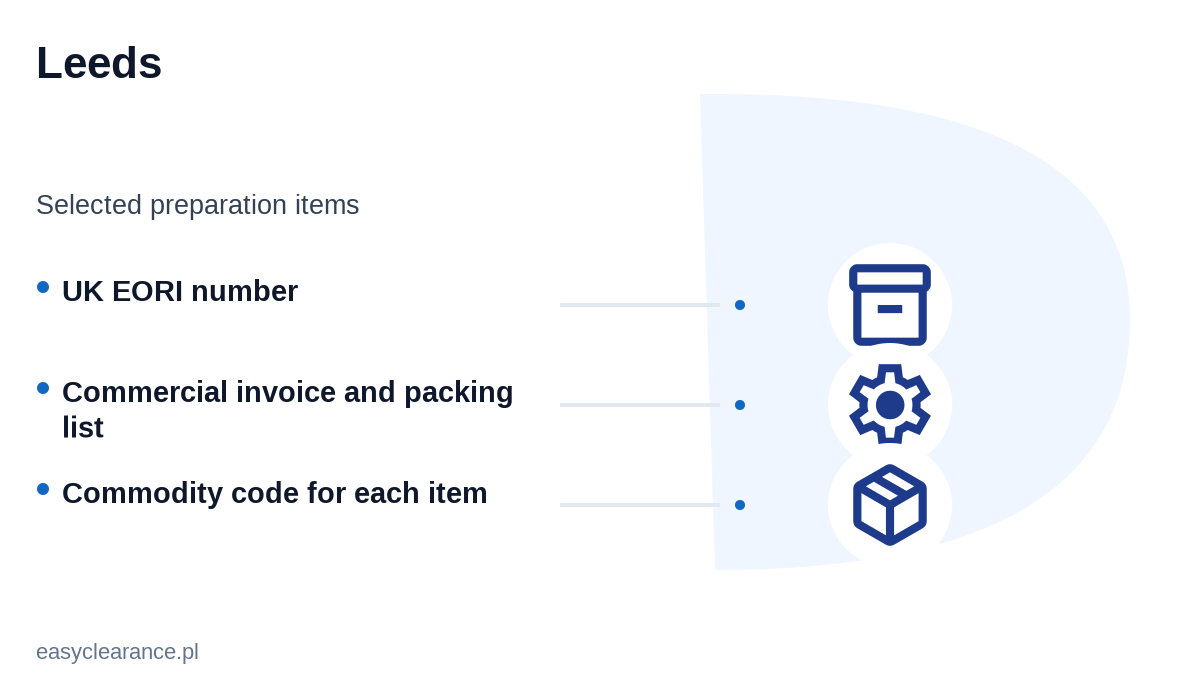
Before goods are shipped from Poland or elsewhere in the EU, have these ready:
- UK EORI number — needed to move goods between Great Britain and the EU (GOV.UK; see also our EORI guide)
- Commercial invoice and packing list — with a description of the goods, quantities, weights and values
- Commodity code for each item — it determines the duty rate and any controls (finding commodity codes)
- Proof of origin — to claim a preferential (zero) rate under the UK–EU Trade and Cooperation Agreement: a statement on origin made out by the exporter or the importer's knowledge (GOV.UK)
- UK VAT number — if you want to use postponed VAT accounting, the VAT registration number must be on the import declaration (GOV.UK)
Send the documents through the contact form or on WhatsApp at +44 7404 091503. Fees are on our pricing page.
Official sources
- GOV.UK — Get an EORI number
- GOV.UK — Finding commodity codes for imports or exports
- UK Integrated Online Tariff
- GOV.UK — Claiming preferential rates of duty between the UK and EU
- GOV.UK — Check when you can account for import VAT on your VAT Return
- GOV.UK — Get a goods movement reference
- GOV.UK — List of ports using the Goods Vehicle Movement Service
- GOV.UK — Check if you can use transit
- GOV.UK — Getting someone to deal with customs for you
- ABP — Port of Hull
Updated: 19 October 2026. This guide is general information, not legal advice; always check the current GOV.UK guidance for your goods.