UK Freeports explained: how the Freeport customs procedure works
Selling to a business inside a UK Freeport? In a Freeport customs site, duties, import VAT and trade measures can wait while imported goods are stored or processed, and become due when the goods are declared from the procedure to free circulation. Here is how the procedure works, and what it does not do.
Author
easyclearance.pl teamPublished
24 October 2026
Updated
24 October 2026
Key points
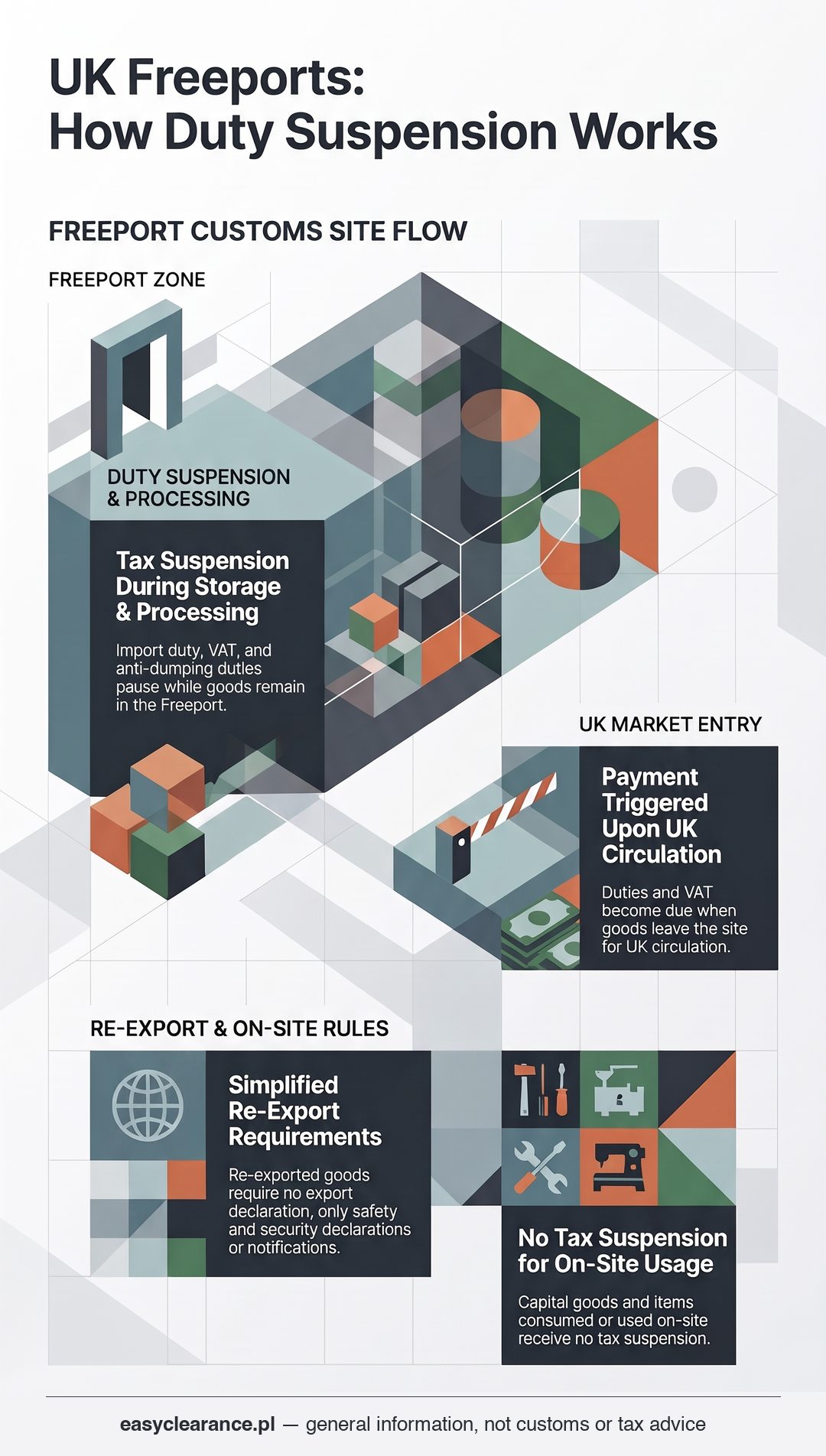
- In a Freeport customs site, duties, import VAT and trade measures such as anti-dumping or safeguard duties are suspended while imported goods are stored or processed under the Freeport customs procedure.
- Charges are paid when goods are declared from the procedure to free circulation in the UK.
- Goods used or consumed in the site, such as capital goods or construction materials, get no suspension.
- Businesses must be authorised for the Freeport customs special procedure. The procedure needs authorisation, not a particular type of agent.
- No export declaration is needed on re-export, but an export safety and security declaration (goods held over 14 days) or an onward export notification (within 14 days) is.
What a Freeport customs site is
A Freeport customs site is an area where imported goods can be held under the Freeport customs special procedure. According to the GOV.UK Freeports handbook, duties, import VAT and any applicable trade measures, such as anti-dumping or safeguarding duties, are suspended while imported goods are stored or processed in the site under that procedure. Each site is run by a customs site operator, an authorised operator responsible for the site. The same guidance also applies to Green Freeports in Scotland unless stated otherwise.
The suspension is not an exemption. When the goods leave the procedure for free circulation in the UK, a declaration is made and the customs charges are paid.
What is suspended, and what is not
The suspension covers imported goods that are stored or processed in the site. It does not apply to imported goods brought into a customs site for use or consumption there, for example:
- capital goods;
- goods or materials used in construction within the site;
- goods used to manufacture equipment for processing goods within the site.
Such goods can be stored under the procedure for a time, but before they are used or consumed, they must be declared to free circulation and the charges paid. Some goods are not permitted in a customs site at all; HMRC publishes them in a public notice.
Who needs authorisation
Before declaring goods to the Freeport customs special procedure, a business must be authorised. HMRC describes this as a single authorisation combined with easier declaration requirements. Alternatives exist: a business authorised for customs warehousing can store imported goods with import duties suspended in a customs site, and a business authorised for inward processing can process goods there if the site is listed in its authorisation (see our guide to inward processing).
The handbook also says that where a Freeport business uses a customs intermediary who is not itself authorised for the procedure, the intermediary must act in a direct capacity for the business. So what the procedure requires is the right authorisation, not a particular kind of agent.
Need operational support?
Send a quick brief and get a clear next-step plan.
Getting goods into a Freeport customs site
Goods entering Great Britain can be declared to the Freeport procedure before they arrive or once they have arrived. They cannot leave the control of the port until HMRC confirms they can be released to the customs site, and presentation and clearance cannot take place inside the free zone itself. Main routes include:
- a customs clearance request (form C21) using the Freeport procedure codes for non-controlled goods, with no supplementary declaration;
- a full declaration using the Freeport procedure code;
- simplified declaration procedures, if authorised (with exceptions, for example where the goods were already declared to another special procedure);
- a declaration by conduct for non-controlled goods arriving from temporary storage next to the site or under transit, by receiving the goods, telling the site operator and making an entry in your commercial records.
Controlled goods, such as goods subject to excise or to anti-dumping, countervailing or safeguard duties if released for free circulation, need a standard declaration (or simplified procedures where authorised). Excise goods must go to a free zone excise warehouse.
Processing and paying duty
Processing takes place within an agreed throughput period. Within 30 days after it ends, processed goods must be declared to another procedure or to free circulation, or allocated in the records to storage under the Freeport procedure. The handbook says the declarant may elect to have the import duty liability determined by reference to the goods as they stood when declared to the procedure, rather than as processed goods. For some goods, for example those subject to trade measures, the liability must always be based on the goods as they entered the procedure.
When goods are released to free circulation, import VAT is due like any other import. A VAT-registered importer may be able to account for it on its VAT return; check the conditions for postponed VAT accounting.
Re-exporting from a Freeport
An export declaration is not required for goods under the Freeport procedure. Instead:
- if the goods have been held in the free zone for more than 14 days before re-export, an export safety and security declaration is required;
- if they are re-exported within 14 days of acceptance of the original declaration to the procedure, an onward export notification is required.
In both cases the declaration states the number of days the goods have been held in the free zone, and evidence that the goods are to be removed for export must be provided to the customs site operator.
Records and VAT between Freeport businesses
Records must be kept for at least 5 years after the goods are discharged from the procedure, covering everything brought in, stored, processed and removed. Supplies of Freeport procedure goods between authorised free zone businesses are zero-rated for VAT where the normal conditions are met, and the VAT invoice must refer to "free zone".
What this means for EU exporters
If your UK customer operates in a Freeport customs site, the goods still travel as an import into Great Britain: you need the usual export formalities on the EU side, and the haulier needs the right references for any GMR (see GMR and GVMS explained and our complete guide to exporting to the UK). The difference is that duty and import VAT are suspended while the goods stay in the procedure. Agree in the contract who holds the Freeport authorisation and who declares the goods into the procedure.
Easy Clearance is a customs agency registered in CDS with a UK EORI. To discuss the export side and the UK import declarations for your shipment, contact us.
Official sources
- GOV.UK: Freeports handbook — using a Freeport customs site — GOV.UK / HMRC, checked 2026-10-24
- GOV.UK: Declaring goods and paying tax when using a UK Freeport customs site — GOV.UK / HMRC, checked 2026-10-24
- GOV.UK: Freeports technical handbook — GOV.UK / HMRC, checked 2026-10-24
FAQ
Do goods in a UK Freeport ever pay duty?
Yes, when they leave the procedure for free circulation in the UK. Duties, import VAT and trade measures are suspended while goods are stored or processed in the customs site, not waived. Goods used or consumed in the site get no suspension.
Can anyone use a Freeport customs site?
No. A business must be authorised for the Freeport customs special procedure before declaring goods to it. Businesses with customs warehousing or inward processing authorisations can use a customs site under those procedures instead.
Do I need a customs agent to use a Freeport?
The procedure requires authorisation, not a particular agent. If a Freeport business uses an intermediary who is not authorised for the procedure, the intermediary must act in a direct capacity for that business.
Is an export declaration needed when goods leave a Freeport for abroad?
No export declaration is required for goods under the Freeport procedure. An export safety and security declaration is needed if the goods were held for more than 14 days, or an onward export notification if they are re-exported within 14 days.
Is import VAT suspended too?
Yes. Import VAT is suspended along with duties and trade measures while goods are stored or processed in the site, and becomes due when the goods are released to free circulation.
Disclaimer: This article is general information on the rules as they stand in October 2026. It does not constitute legal, tax or customs advice. Check the official sources for your specific goods and situation.
Moving goods into or out of a UK Freeport?
We handle UK import clearance and EU export formalities. Ask us which declarations your shipment needs.