Selling to the UK from Poland or the EU: the complete 2026 guide
Selling to Britain from Poland or another EU country means exporting from the EU and importing into Great Britain (England, Scotland and Wales). Northern Ireland follows separate rules under the Windsor Framework and is not covered here.
Author
easyclearance.pl teamPublished
24 October 2026
Updated
24 October 2026
Key points
- You need an EORI number starting with GB to import into Great Britain; an EU EORI is not enough.
- A business not established in the UK can import only through an indirect representative, who is jointly and severally liable.
- The £90,000 UK VAT threshold does not apply to non-established businesses: they register if they make taxable supplies of any value in the UK, within 30 days.
- For consignments of £135 or less sold directly to GB consumers, UK VAT is charged at the point of sale, not at the border.
- CE marking is still recognised in Great Britain alongside UKCA for a range of product rules.
1. A GB EORI
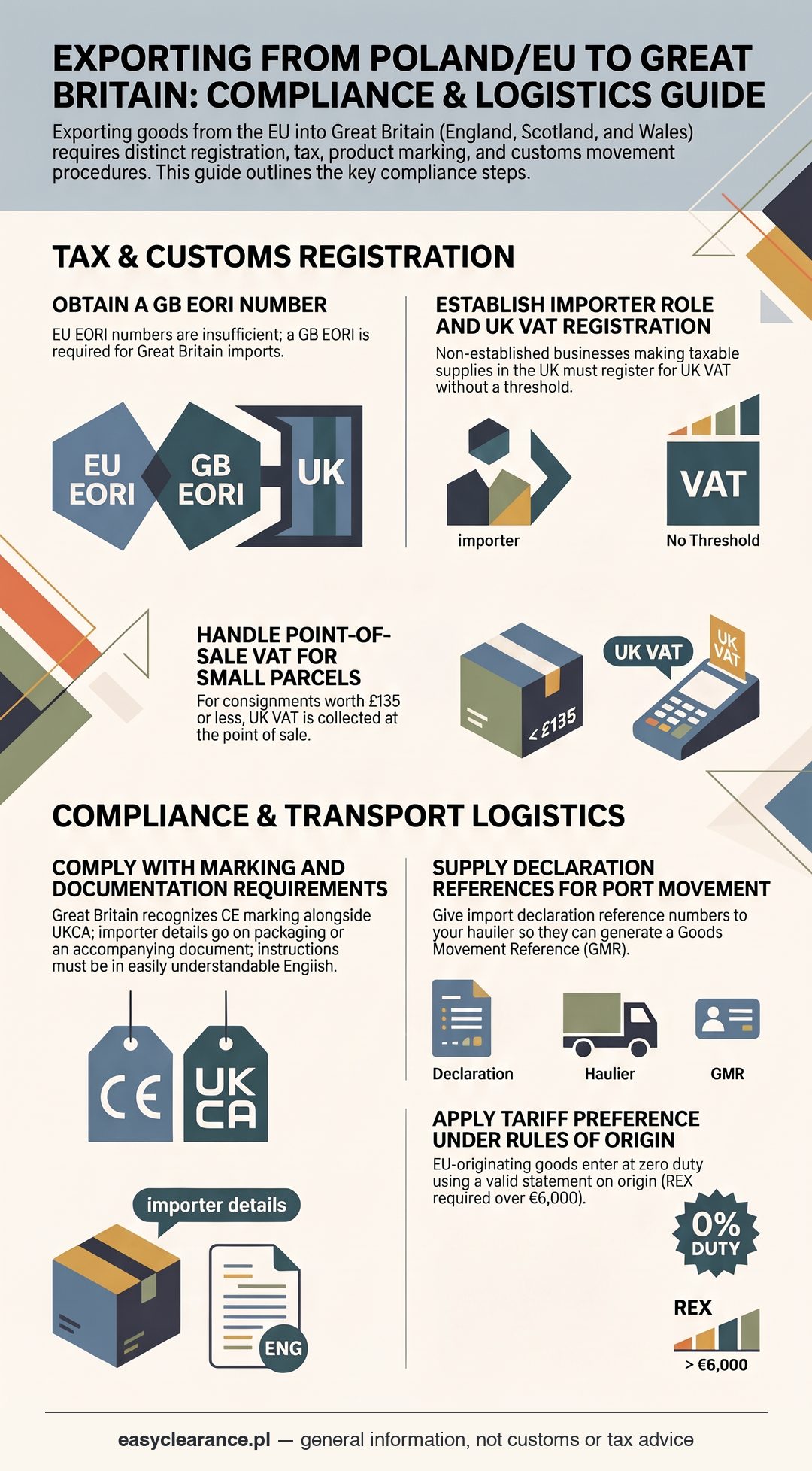
HMRC says you need an EORI number that starts with GB to import goods into England, Scotland or Wales; a number from an EU country is not enough. Businesses based outside the UK can apply too, without a UK tax reference, an industry classification code or a National Insurance number. You usually get the number straight away; if HMRC needs to make checks, it can take up to 5 working days. For Northern Ireland, an EU EORI is enough.
2. Who is the importer?
The person who makes the import declaration, or in whose name it is made, is liable for the customs debt. If your UK customer has a GB EORI and the import is declared in its name, it is liable for the duty and import VAT. If you arrange the import yourself, for example when you deliver duty paid, the declaration is made in your name through a representative and you become liable.
HMRC guidance is clear that a business not established in the UK, importing into Great Britain, can only ask someone to act indirectly on its behalf. The agent acts in its own name, and you are jointly and severally liable. A company counts as established if it is incorporated at Companies House or has a permanent place in the UK where it carries out business; a UK VAT or EORI number alone does not prove it.
3. UK VAT: no threshold for non-UK businesses
A UK business only has to register for VAT when its taxable turnover goes over £90,000. That threshold does not apply to non-established businesses. HMRC says a non-established taxable person must register if it makes taxable supplies of any value in the UK, within 30 days of making the supply or of expecting to make one. HMRC also treats you as an overseas seller if you sell goods to customers in Great Britain and then import them yourself. A UK tax representative or agent is optional unless HMRC directs you to appoint one, and HMRC cannot direct businesses based in countries where certain mutual assistance arrangements exist. See exporting goods to the UK: complete guide.
Need operational support?
Send a quick brief and get a clear next-step plan.
4. Parcels of £135 or less
For consignments worth £135 or less that are outside the UK and sold directly to customers in Great Britain, UK VAT is charged at the point of sale, by you, not at the border. The limit applies to the whole consignment, not to each item, and you need to be registered for UK VAT. If the buyer is a UK VAT-registered business and gives you its VAT number, you do not charge VAT; the customer accounts for it under the reverse charge. Sales through online marketplaces follow separate rules, and above £135 the normal import rules apply. The £135 rules do not apply to consignments containing excise goods or to non-commercial goods such as gifts. Details in our guide to the £135 e-commerce VAT rule.
5. Import VAT and postponed VAT accounting
When goods are imported as normal freight, import VAT is due. A business registered for VAT in the UK can use postponed VAT accounting (PVA): it declares and recovers the import VAT on the same VAT return instead of paying it upfront, and no separate approval is needed. A business without a UK establishment has to get someone to deal with customs for it and must tell that person, in writing, to select postponed accounting and to enter its details as the consignee. Without UK VAT registration, PVA is not available. More in our guide to postponed VAT accounting.
6. UKCA, CE and the importer's address
Under the Product Safety and Metrology etc. (Amendment) Regulations 2024, Great Britain continues to recognise the CE marking alongside the UKCA marking for a range of product regulations, so you can usually rely on EU conformity procedures. Medical devices, construction products, marine equipment, rail products, cableways, transportable pressure equipment and uncrewed aircraft have specific rules, so check the sector guidance before relying on CE. Whatever the marking, the UK importer, a business established in the UK, must show its name and postal address. For products imported from the European Economic Area before the end of 2027, those details may go on the packaging or an accompanying document. Instructions must be in easily understandable English.
7. Road freight: the GMR
If your goods travel by lorry through a port that uses the Goods Vehicle Movement Service (GVMS), a goods movement reference (GMR) is needed for movements from the EU to Great Britain. The haulier creates it and must enter references for all goods in the vehicle, trailer or container, so you or your customs agent must give the haulier the right reference before the goods reach the departure port. Which reference that is depends on the procedure:
- if the import was declared in the Customs Declaration Service (CDS) before arrival, the GMR carries the import MRN;
- for goods moving under Common Transit Convention transit, the GMR carries the transit MRN from NCTS, and associated import declaration references must not be included;
- ATA and TIR carnet movements use the carnet reference, and traders authorised to declare in their own records use their EORI.
Whether you need a GMR depends on the port: it is needed for movements through ports that use GVMS. Which reference goes into it depends on the procedure. For this direction, adding the safety and security entry summary declaration reference is optional. See GMR and GVMS explained.
8. Rules of origin
Goods originating in the EU can enter Great Britain at zero duty under the Trade and Cooperation Agreement, if the importer claims the preference, usually on the basis of a statement on origin on your invoice. An EU exporter needs a registered exporter (REX) number for consignments worth more than 6,000 euros, and for imports into the UK the statement is valid for 2 years from the date it was made out. See TCA zero tariffs and rules of origin.
Your checklist
- GB EORI, and a decision on who imports.
- UK VAT registration check, then PVA.
- UKCA or CE marking, and the UK importer's details.
- GMR references for the haulier and a statement on origin.
Easy Clearance is a customs agency registered in CDS with a UK EORI. For export and UK import clearance, contact us or see our export clearance page.
Official sources
- GOV.UK: Get an EORI number — GOV.UK / HMRC, checked 2026-10-24
- GOV.UK: Check what you need to consider before getting someone to deal with customs for you — GOV.UK / HMRC, checked 2026-10-24
- GOV.UK: VAT Notice 700/1 — should I be registered for VAT? — GOV.UK / HMRC, checked 2026-10-24
- GOV.UK: VAT and overseas goods sold directly to customers in the UK — GOV.UK / HMRC, checked 2026-10-24
- GOV.UK: Check when you can account for import VAT on your VAT Return — GOV.UK / HMRC, checked 2026-10-24
- GOV.UK: Placing UKCA or CE marked products on the market in Great Britain — GOV.UK / DBT, checked 2026-10-24
- GOV.UK: Create a goods movement reference — GOV.UK / HMRC, checked 2026-10-24
- GOV.UK: Proving originating status and claiming a reduced rate of customs duty (UK–EU) — GOV.UK / HMRC, checked 2026-10-24
FAQ
Is my EU EORI number enough to import into Great Britain?
No. HMRC says you need an EORI number starting with GB to import into England, Scotland or Wales. For Northern Ireland an EU EORI is enough.
Do I need a UK company or UK VAT registration just to clear goods through customs?
No. A business not established in the UK can import into Great Britain through an indirect representative, who is jointly and severally liable. UK VAT registration depends on whether you make taxable supplies in the UK; non-established businesses have no threshold.
Which reference goes into the GMR for EU to GB movements?
It depends on the procedure. For an import declared in CDS before arrival, the import MRN. For Common Transit Convention transit, the NCTS transit MRN, without import declaration references. The ENS reference is optional for EU to GB movements. A GMR is needed for movements through ports that use GVMS, so check whether your port does.
Is CE marking still accepted in Great Britain?
Yes, for a range of product regulations. Under the Product Safety and Metrology etc. (Amendment) Regulations 2024, Great Britain continues to recognise CE alongside UKCA. Some sectors, such as medical devices and construction products, have separate arrangements.
How long is a statement on origin valid for imports into the UK?
GOV.UK says that for imports into the UK the statement on origin is valid for 2 years from the date it was made out; for exports to the EU it is valid for 12 months.
Disclaimer: This article is general information on the rules as they stand in October 2026. It does not constitute legal, tax or customs advice. Check the official sources for your specific goods and situation.
Sending your first consignment to Great Britain?
We handle EU export formalities and UK import clearance. Tell us about your goods and route, and we will set out the next steps.